Als Mensch führen
Leading as a human being. For people who take responsibility.
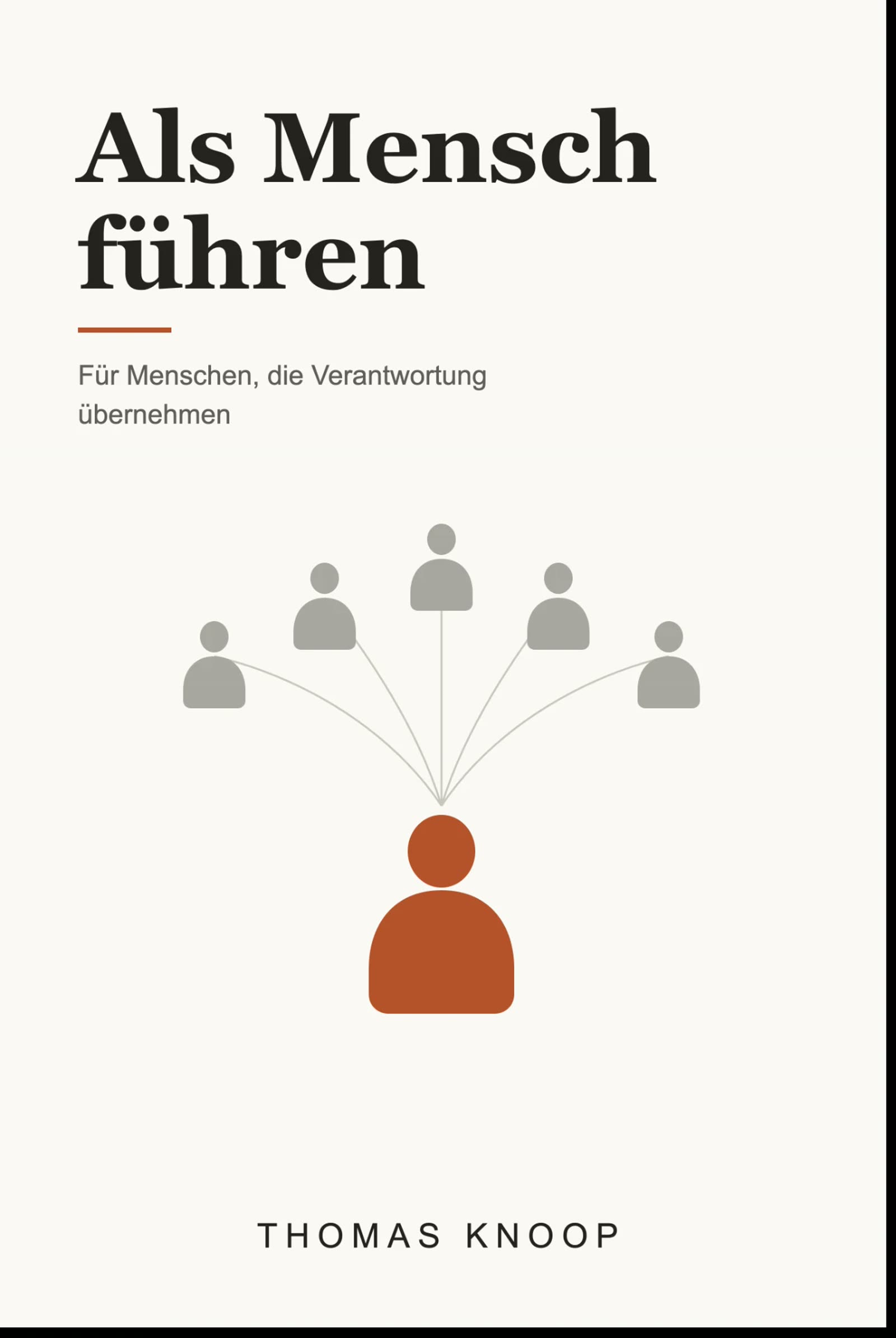
"You shall not steal other people's problems either." This sentence, spoken by a pilgrim on the Camino de Santiago, changed my view of leadership – and stands at the beginning of “Als Mensch führen”.
The book brings together twelve principles that have proven durable across more than 20 years of leadership responsibility and more than 1,000 coaching sessions. The book is written in German.
What the book is about
The book does not offer one model that explains everything. It describes situations that keep returning in leadership: a conflict that cannot be solved on the content level. A decision that is not ripe yet. A team member whose development cannot be accelerated. And the moment you notice that someone else's problem has quietly become your own.
Each principle is written so that it can be tested against your own working day: the situation, the mechanics behind it, and a question you can ask yourself.
Beyond the twelve principles, the book contains nine practice sections under the heading “Für die nächste Woche” (for the coming week). Each one closes a chapter and turns it into something you can try out over the following days. One of them is the Tuesday Evening Test, a ten-minute exercise for checking how much of your own working day originated on someone else's desk. You can find it here in full and free of charge, with both rounds.
The Insights on this website are the facets of that work. Reading them shows you the individual stones. The book shows the picture they form, and how the themes connect: responsibility with the circle of influence, the façade with courage, the second before reacting with the art of letting a decision ripen.
Who it is written for
For leaders who already carry responsibility and want to sharpen their effect. For people in their first leadership role who are looking for orientation. For managing directors and founders moving from doing to leading. And for HR leaders who do not want to think of leadership development as a catalogue of trainings.
Twelve principles in three clusters
I. Stance
Where leadership begins, long before any method is applied.
- 01Responsibility stays with the other person.
- 02Effectiveness comes from the circle of influence, not the circle of concern.
- 03Authenticity beats facade.
- 04Leadership needs courage and inner independence.
II. Leadership craft
What actually helps between conflict, decision and priority.
- 05No content level while emotions are in the way.
- 06The second before the reaction is the lever.
- 07Not deciding can be the mature decision.
- 08Time management is really priority management.
III. People and development
How people grow, and why development cannot be accelerated.
- 09People before strategy.
- 10Development cannot be forced, and detours are part of the path.
- 11A change of perspective creates new solution space.
- 12Up is not the only direction.
Book details
- Title
- Als Mensch führen
- Author
- Thomas Knoop
- Language
- German
- ISBN (paperback)
- 978-3-00-087978-4
- E-book release
- 13 August 2026
- Paperback release
- 20 August 2026
- Pages
- 141 pages
- Practice sections
- 9
- Publisher
- Selbstverlag Thomas Knoop
The e-book and the paperback are both available.
Frequently asked questions about the book
- Where can I buy “Als Mensch führen”?
- Both the paperback and the e-book are available exclusively through Amazon.
- Why only through Amazon?
- The book is self-published through Amazon KDP. That keeps the effort deliberately lean and allows for fast, straightforward publication.
- Does the book contain practical exercises?
- Yes. Nine chapters close with a practice section, “Für die nächste Woche”, that turns the principle into concrete steps for the days ahead. One of them, the Tuesday Evening Test, is available to try free of charge beforehand.
After reading
The book ends with an invitation: to take two hours, alone or with someone allowed to disagree. For many readers that is where the work actually begins. If you would rather not take that step alone, an introductory conversation is the simplest way to start. It is free and commits you to nothing.
The twelve principles are laid out in full on this site, with links to the matching articles. My first book remains available.