"Peter doesn't like frog for breakfast."
A book on selected leadership situations: management lessons from 15 years of leadership experience, from First who, then what through the harbour master principle to the Peter Principle and Maslow's hammer. The starting point of my insights. (German edition.)
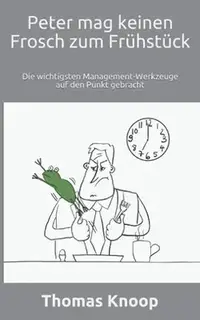
A book on selected leadership situations
A new book is out: “Als Mensch führen” brings together twelve principles of good leadership in three clusters. → Als Mensch führen
The title is a triple wink. The frog is the “frog” from Brian Tracy's “Eat That Frog”, the unpleasant task you should tackle first. Breakfast points to Peter Drucker's famous line: “Culture eats strategy for breakfast.” And the name “Peter” nods to Laurence Peter, whose principle shapes one of the chapters. Three allusions in one title, for a book that grew out of many situations from everyday leadership.
This is not a book about the Peter Principle. It is a collection of selected leadership situations I encountered again and again over 15 years as a leader: why it is wiser to first find the right people and then set the strategy. Why teams that try to do everything in parallel end up slower than teams that focus. Why knowing a method is not the same as being able to apply it. Why sometimes the stronger leadership decision is not to decide. And why we so often work on new problems with the tools that helped in old crises.
The Peter Principle is one of these chapters: in hierarchies, people are promoted until they reach a position where they are no longer effective. The book takes this principle seriously without becoming cynical, and asks how organisations and individuals can deal with careers differently, without “voluntarily not stepping up” feeling like a setback.
From the book to the insights
Several chapters have grown into standalone articles on this site. The book is the starting point, the insights are the deep dive.
Chapter “Peter's Principle” – Why promotions fail and nobody steps back. About the three invisible costs that prevent a step back: salary, status and identity. → Why nobody steps back
Chapter “First Who, Then What” – Jim Collins' surprising research finding: the right people matter more than the right strategy. Extended with Frederic Laloux's organisational colours and the question why “right” depends on the culture of an organisation. → First Who, Then What
Chapter “The harbour master principle” – Three ships, three unloading teams, one simple calculation. Why focusing on one thing is faster than working in parallel – and why leaders still keep doing everything at once. → The harbour master principle
Chapter “Grass doesn't grow faster” – How careers in large companies actually work. About high-impact projects, golden handcuffs and the calm it takes not to force the next step. → Grass doesn't grow faster
Chapter “Knowing is not being able” – Why I did my coaching training twice and what the four stages of learning have to do with leadership competence. → Why I did my coaching training twice
Chapter “Sometimes don't decide” – John Keats called it negative capability: the ability to stay in uncertainty without reflexively reaching for a solution. Why this is not a weakness but a leadership virtue. → When you can't decide
Chapter “Maslow's hammer” – If the only tool is a hammer, every problem looks like a nail. About cognitive bias in leadership and the art of widening your toolkit. → When the hammer is the only tool
Who the book is for: leaders, HR and founders
For leaders asking themselves whether the next step really is theirs. For HR leaders who no longer want to think of promotions as rewards only. For founders shaping the transition from doer to leader. For coaches and coachees working on careers, self-assessment and decision-making. And for everyone who wants to discover the Paula Principle without it remaining a footnote.
Frequently asked questions about the book
- Where can I buy the book?
- The book is available on Amazon.
- Is there an English edition?
- The book is currently published in German. An English edition is planned.
- Do you give readings or talks on this topic?
- Yes. The themes of the book work well as a keynote for HR and leadership audiences: from the Peter Principle to team culture and the question when not deciding is the better decision. More under Trainer, facilitator & conflict coach.
Want to talk about the book or a reading?
Get in touch