What the Camino de Santiago Teaches About Collaboration
On the Camino, strangers help each other as if it were the most natural thing in the world. The anthropologist Victor Turner called this communitas. What makes the Way different from everyday life, and which of its conditions leaders can bring into their teams.
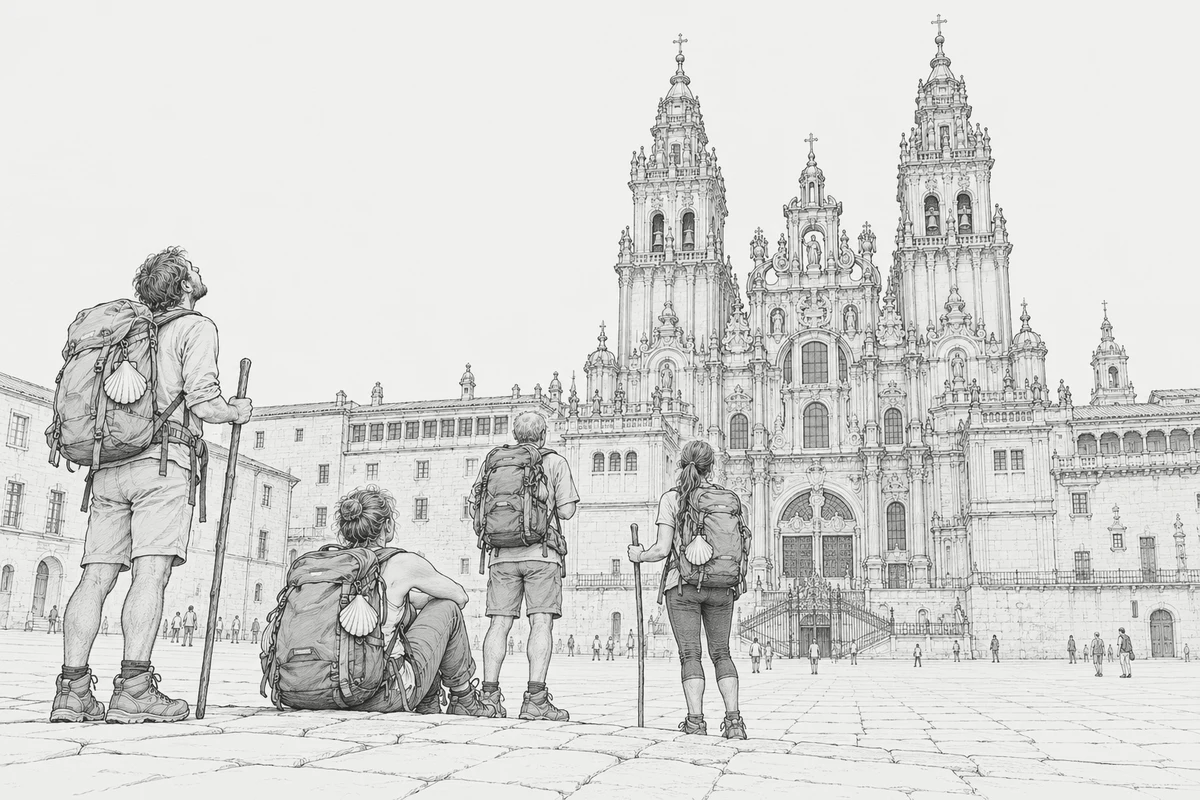
This month I walked the Camino Inglés, the "English Way", from Ferrol on the north coast of Spain to Santiago de Compostela. Along the way I was in the company of people between 21 and 75, women and men from Singapore, Italy, the USA, Ukraine and Spain. Where someone comes from, whether someone has much or little, whether young or old, played no visible role. People were friendly to one another and helped each other. One moment I experienced myself, and one story I heard in Santiago, have stayed with me in particular.
At dinner I sat at a table with other pilgrims, among them two women who had only just met. One of them was worried. On one of the next stages the local hostel has only twenty beds, reservations are not possible, and there were clearly many more pilgrims on the Way. The other woman spontaneously said she had private accommodation and offered to let her stay with her.
In Santiago I heard the story of a visually impaired pilgrim who had walked the Camino Portugués. Along the way he had serious trouble with blisters on his feet, which he could barely see and therefore could not treat himself. Others from his chance pilgrim group took care of this, people who had not known him before the Way.
Since then one question has stayed with me. Why does something succeed so naturally on the Way that we so often find difficult in everyday life, in teams and in organisations?
What makes the Way different
The anthropologist Victor Turner coined a term for this phenomenon, which he developed partly through the study of pilgrimage: communitas. People leave their familiar order and enter an in-between state in which status, role and origin lose their weight. On the Camino this can be observed very concretely. Everyone carries a backpack and wears hiking boots, nobody knows what position the other holds at home, and everyone struggles with the same climbs and the same blisters. The effort is visible and shared, the goal is common, and there is hardly anything to compete over. Even the scarce bed in the hostel became, in the first scene, an occasion for generosity.
Then there is time. You meet for a few days, without future dependencies and without a reputation to manage. A small ritual such as the greeting "Buen Camino" frames every encounter in a friendly way from the outset.
The evening is also part of the Way's rhythm. Every stage ends with a goal reached, and in the restaurants and bars of the mostly small villages the pilgrims come together and celebrate having arrived. These evenings are an essential part of what makes up the community and the feeling of the pilgrimage. The experience reaches its high point on the square in front of the cathedral in Santiago de Compostela. Arriving there together, when everyone has made it, was an uplifting moment for me, one in which the many stages and evenings came together.
What happens within us
From the perspective of Internal Family Systems, this can be described more precisely. Within each of us there are parts whose task is protection. They watch out for judgement, for competition, for possible loss of face, and in working life they have a great deal to do, because roles, targets and hierarchies genuinely carry risks. On the Way many of these signals fall away. The protectors may step back, and beneath them appears what is already within us: care, curiosity, the willingness to bandage a stranger's feet. Seen this way, the pilgrims' friendliness arises from safety. It becomes possible as soon as people feel safe enough.
Where the comparison reaches its limits
In all honesty, two qualifications are needed. Those who walk the Camino often bring openness with them; to some extent the Way selects its people. Communitas also depends on coming to an end. In a company we work together for years, allocate budgets, decide on promotions and deal with real conflicts of interest. These tensions cannot be wished away. That is exactly why it is worth looking closely at which conditions of the Way can still be carried over.
What leadership can take from it
A shared goal that everyone can feel creates a stronger bond than one that exists only in a strategy paper. Team leads or managing directors who keep making the goal tangible create something of the Way's orientation towards Santiago. Shared, visible effort has a similar effect. Leaders who are present in difficult phases and help carry the load reduce the distance that hierarchy otherwise creates.
On the Way there is also a performance principle, interpreted in a very human way. Everyone walks the Camino as far as their own strength allows. Some have their backpack transported from hostel to hostel, others take a taxi for a few kilometres when a climb gets very steep. Even so, the ease of the evening gatherings rests on each person's knowledge of having completed their own stage under their own steam. Belonging here draws on one's own contribution, measured against what is personally possible. For teams this is a valuable opportunity. Expecting everyone to do their part while recognising that this part may vary in size creates a community in which performance counts and support shames no one.
Closely linked to this is celebrating together. On the Camino, what has been achieved that day is honoured every evening, and the celebration has its value precisely because it rests on one's own contribution. In many organisations people pause only at the end of large projects, if at all. Leaders who break goals into manageable stages and mark the reaching of each stage together give their team a regular sense of arrival. This needs no grand setting; a shared meal after a milestone can be enough. Once the big goal is reached, it deserves a moment of its own, like the arrival on the square in front of the cathedral. Its power comes from everyone having arrived and no one having been left behind.
There are also opportunities in reducing visible status differences. Status can be consciously set aside, in meetings, in seating arrangements, in language, in small gestures. Rituals such as a fixed moment of appreciation at the end of each week can frame things much as the greeting between pilgrims does. Accepting help should be as normal as giving it. The pilgrim with the blisters could only have his feet cared for because he was allowed to show his limit. Amy Edmondson calls the precondition for this psychological safety: the confidence that one can show vulnerability in a group without being punished for it.
What matters most may lie in the attitude behind all this. Those who lead shape, to a large extent, how much protection the people in their team need. The less they have to defend themselves, the more of what I experienced on the Camino becomes possible in everyday life as well. Perhaps this is exactly what we mean when we speak of leading as a human.
Further reading
- Victor Turner: The Ritual Process (1969) – Foundational work on liminality and communitas.
- Victor and Edith Turner: Image and Pilgrimage in Christian Culture (1978) – Communitas in the context of pilgrimage.
- Amy Edmondson: The Fearless Organization (Wiley 2018) – Psychological safety in teams.
- My book Als Mensch führen – Twelve leadership principles from more than twenty years of leadership responsibility (German).
- Where we look last for answers – A systemic view of one's own inner state as a lever.
Frequently asked questions
- What does communitas mean?
- Communitas is a term coined by the anthropologist Victor Turner. It describes the community that emerges when people leave their familiar order and enter an in-between state in which status, role and origin lose their weight. Turner developed the concept partly through the study of pilgrimage.
- What can leaders learn from the Camino de Santiago?
- Several conditions of the Way can be carried over: a shared goal that everyone can feel, visibly shared effort, an understanding of performance that measures each contribution against what is personally possible, celebrating stages reached together, reduced status and psychological safety in which accepting help is as normal as giving it.
- Why is collaboration harder at work than on the Camino?
- From the perspective of Internal Family Systems, protective inner parts are more strongly engaged at work, because roles, targets and hierarchies carry real risks. Long-term dependencies and conflicts of interest add to this. On the Way many of these signals fall away, and care and helpfulness can come through. Leadership has a major influence on how much protection people in a team need.
Particularly relevant for
Want to read this offline or share it?
Related posts
Where we look last for answers
An old parable about inner peace meets a systemic principle: when something outside is stuck, the most reliable lever lies in our own state and our own behaviour.

The Emotional Veto: When One Person Shifts the Rules for Everyone
One team member reacts so strongly to criticism, conflict or change that everyone eventually begins to organise themselves around his reactions. That creates a veto nobody ever granted him.