Reclaiming the Circle of Influence in a Job Search
After years of responsibility, waiting for a reply means checking your inbox constantly. Covey's Circle of Influence and three clear axes of package, location and content give the ground back.
In my work one concern is showing up particularly often right now. Leaders who, after years of responsibility, are looking again, frequently in the wake of layoffs, in a market that has visibly narrowed. The search drags on, and it drains. Anyone living through this knows the small gesture that creeps in: checking the inbox constantly, hoping that one of the open applications has finally produced an answer or that the promised reply has now arrived.
The familiar reach for the inbox
The gesture is deeply understandable. It is an attempt to claw back a piece of control in a situation that offers very little. Its target, however, lies outside one's reach. Whether a company replies, when, and in what form, is entirely beyond one's own doing. Stephen Covey coined a clarifying image for this. Around us lies a wide Circle of Concern with everything that occupies us, and inside it a smaller Circle of Influence with what we can actually affect. The more energy flows into the Circle of Concern, the smaller the Circle of Influence feels. Repeatedly checking the inbox is pure work in the Circle of Concern. It costs energy and gives nothing back.
Three axes, three degrees of freedom
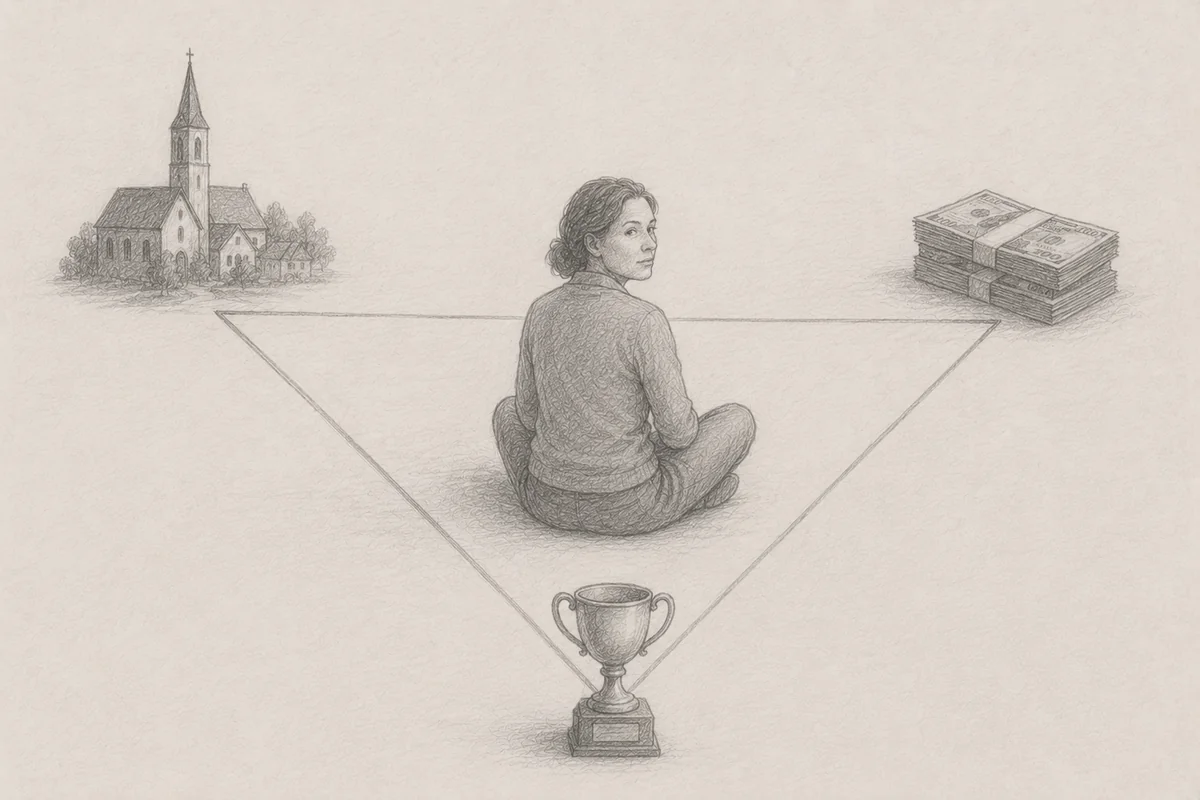
The calmer and at the same time more effective movement leads inward, into the Circle of Influence. That is where the real work waits, and it has a clear shape. A new role is decided along three axes: the package of compensation and conditions, the location, and the content, that is, the actual challenge. The more tightly one holds all three at once, the smaller the set of what is even possible. The decisive question is therefore on which axis one allows degrees of freedom. Is commuting or relocation thinkable? Would a sector change or self-employment be an option? How much less income would be bearable without putting one's own commitments at risk?
What the pyramid no longer carries
These three axes roughly correspond to three levels of human needs as Abraham Maslow described them. The package touches material security, the location belonging, the content the striving for impact and self-realisation. The well-known pyramid suggests that the lower levels have to be secured before the upper ones may count. This is exactly what newer research no longer supports. A large study by Louis Tay and Ed Diener across 123 countries and more than sixty thousand people confirmed that these needs exist but disproved their rigid order. People experience belonging and meaning even when their material situation is tight, for example those who live on a small income and yet experience their own work as deeply coherent. Maslow himself never drew the rigid pyramid; it is a later simplification. The package remains important, material security contributes its own share to wellbeing. But it does not have to be complete for the content of a role to truly fulfil. The idea that one must first reach the top in terms of money before content is allowed to count is therefore less a law of nature than a well-fitting myth. Anyone who wants to follow up will find the study in Tay and Diener (2011).
Limits that look firmer than they are
This is where the actual work begins, the work that goes beyond ordinary application tactics. If even the supposedly fixed order of needs is just a myth, then the other limits one sets within the three axes deserve the same examining gaze. Many of them are believed to be firmer than they really are. "Earning less is not an option" or "moving is out of the question" sound like hard facts and are often inherited assumptions that have never been tested. Honestly questioning each supposed limit, whether it is real or merely familiar, often widens the search space more than any additional application. The own commitments in particular deserve this look. As long as fixed costs are treated as immovable, the package feels like a wall. The moment they are questioned, more room sometimes appears there than in the other two axes combined.
Ground under one's feet again
That is the core. The market is steered by no one. Who responds and when stays outside. Inside the Circle of Influence lies everything that counts: which filters one sets, which assumptions one tests, where one directs the day's attention. Whoever directs their energy there gains back something that makes the search easier. Clarity about one's own room to move, and a calmer centre from which the next decision falls.
If you are in a professional reorientation yourself and want to work through your three axes, the page Executive coaching for stuck leadership situations describes my work in more detail. A free orientation call can be arranged easily here.
One procedure for that is the Tuesday Evening Test: ten minutes, a sheet of paper, and the day's topics sorted by circle of influence and circle of concern.
Further reading
- FranklinCovey: Habit 1 – Be Proactive (Circle of Influence) – Official source on Stephen R. Covey's model.
- Tay, L. & Diener, E. (2011): Needs and Subjective Well-Being Around the World – The 123-country study that empirically dismantles the strict order of Maslow's pyramid.
- When the Job Wobbles: Circle of Influence – The same model from a different perspective: between job anxiety and termination conversation.
- Maslow's Hammer in the Toolbox – Why a single model is never enough to grasp a professional situation fully.
- 3 levers in the search for a new leadership role – The same topic as a leadership pattern: the three axes of package, location and content from coaching practice.
Frequently asked questions
- What is Stephen Covey's Circle of Influence?
- In "The 7 Habits of Highly Effective People" (1989), Stephen Covey distinguishes two circles. The Circle of Concern holds everything that worries us but lies outside our reach. The Circle of Influence holds everything we can actually shape. Concentrating energy on the inner circle restores agency.
- How do you keep agency during a long job search?
- By consciously separating what you cannot steer (response times of companies, market conditions) from what lies within your influence: the filters you set, the assumptions you test, the degrees of freedom in package, location and content of a new role.
- Is the Maslow pyramid still valid in its strict order?
- No. The study by Louis Tay and Ed Diener (2011) across 123 countries and more than sixty thousand people confirmed the needs but disproved their rigid sequence. Belonging and meaning are experienced even when material conditions are tight. Maslow himself never drew the pyramid that way.
Want to read this offline or share it?
Related posts
When the Job Wobbles: Circle of Influence
On the two sides of job insecurity in mechanical engineering, automotive and steel: the fear of losing your own job and the burden of having to lay others off.

Corporate Careers: Grass Grows in Its Time
On Stephen Covey's Circle of Influence, Deci and Ryan's Self-Determination Theory, and the difference between worry-bearers and shapers in corporate careers.