When the Job Wobbles: Circle of Influence
On the two sides of job insecurity in mechanical engineering, automotive and steel: the fear of losing your own job and the burden of having to lay others off.

In my coaching work with leaders from mechanical engineering, the automotive industry and steel, one topic has been showing up in nearly every session for months now: job security. Not as an abstract slogan, but as a concrete, personal fear.
In 2025 German industry cut more than 124,000 jobs. The automotive sector alone lost around 50,000, the steepest drop of any large industrial branch. Mechanical engineering shed 22,000 positions. Experts expect no relief for 2026. The numbers are not abstract. Behind every figure is a person who wakes up in the morning not knowing whether their role will still exist three months from now. Or a person who has to make exactly that decision for others.
In my coaching practice I meet both sides, often in the same week. On one side the leader who fears for their own job. On the other the leader who has been tasked with cutting headcount in their team. Both are exhausting. Both require different approaches.
Part 1: When your own job feels uncertain
Fear of losing your job is one of the most paralysing emotions in working life. It eats energy, destroys sleep, poisons concentration. And the insidious part: it reinforces itself. People who fear losing their job perform worse, and so raise the very probability of being let go.
The first thing I do with clients in this situation is to introduce a simple but powerful model: Stephen Covey's Circle of Influence.
Circle of Influence and Circle of Concern
In The 7 Habits of Highly Effective People (1989), Covey describes two circles that govern our behaviour. The outer one is the Circle of Concern, everything that occupies us, worries us, affects us. The economy. Board decisions. Order books in the industry. The political climate. All of these are real concerns, but most of them lie outside our influence.
The inner circle is the Circle of Influence, everything we can actually shape. Our own performance. Our visibility inside the company. Our networks. Our continuous learning. The quality of our work. The way we deal with uncertainty.
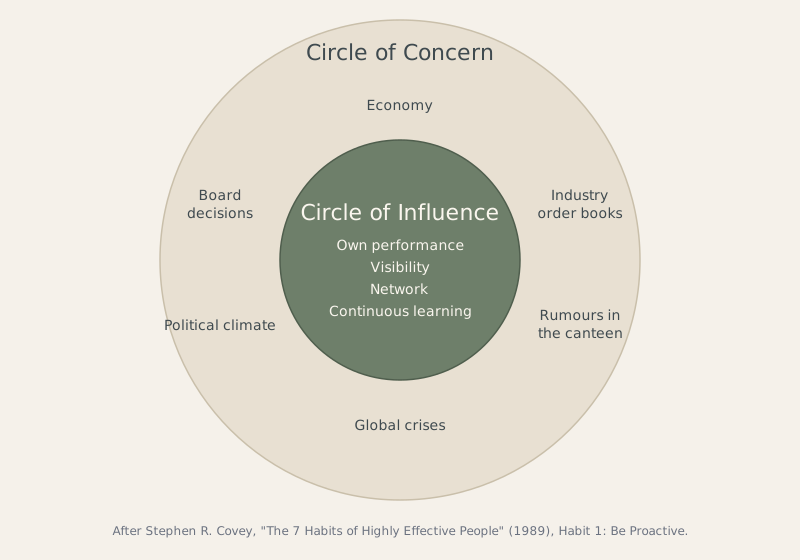
Covey's central insight: when we pour our energy into the Circle of Concern, into things we cannot change, our Circle of Influence shrinks. Fear grows, agency shrinks. When we focus on the Circle of Influence, the opposite happens: the circle of influence expands, because we are acting rather than worrying.
That sounds simple in theory. In practice, when you are lying awake at night wondering whether you will still have a job in three months, it is enormously hard. That is exactly why this is coaching work, not just a chapter in a book.
What this looks like in practice
In coaching we walk through what sits in the Circle of Concern and what sits in the Circle of Influence. The result surprises many clients. They realise that they spend the bulk of their mental energy on things they cannot change, management decisions, the state of the industry, rumours in the canteen. At the same time they neglect the things they can absolutely shape, their visibility with decision-makers, their positioning inside the company, their options on the external job market.
Shifting attention from the Circle of Concern to the Circle of Influence is not a trick. It is a deliberate choice that takes effect immediately: the fear does not disappear, but agency returns. And with agency comes something invaluable in uncertain times: the feeling of not being a victim of circumstances, but actively working on your own future.
Part 2: When you have to do the firing
The other side of the table is no less difficult. Leaders who are told to reduce headcount carry a weight that is rarely talked about. The decision is often not theirs, it comes from above. But the conversation is theirs to lead. Sitting opposite the person. Looking them in the eye. Saying the words.
In my article First the thought, then the feeling I described how I once stood in exactly that situation myself, and how the fear of being judged paralysed me. That experience is why I take this topic so seriously in coaching.
What I work through with leaders before the conversation
When a client is preparing for a termination conversation, we work on three things:
First: Get to the point fast. This is where most leaders fail, not out of coldness, but out of compassion. They start with small talk, they circle around the issue, they hope the employee will somehow guess. It is well meant but cruel. The longer the preamble, the greater the fear on the other side. People sense that something is coming, and uncertainty is worse than the message itself. My recommendation: deliver the core message within the first two minutes. Clear, direct, no detours.
Second: Don't justify. This is counter-intuitive but decisive. Many leaders slide into a justification mode, they explain the economic situation, the order pipeline, the strategic realignment. That is factually correct, but in the moment of the conversation it is wrong. Because the person who has just learned they are losing their job hears no arguments. They hear only one thing: you are not worth it. Every justification sounds like a defence, and defence implies guilt. Instead: name the decision as a fact, not as the conclusion of an argument.
Third: Show empathy, real, not technique. That does not mean putting your own pain centre stage. It means giving the other person room. “I understand this is a shock. Take the time you need." No platitudes, no “This is hard for me too" (which flips the conversation around). Just genuine listening and the willingness to bear the silence that follows.
Why we rehearse the conversation
The most important step in coaching is to play the conversation through. I take the role of the employee, the client leads the conversation. We do not do this once, but two or three times, with different reactions on my side: calm, emotional, confrontational.
Why? Because what you have lived through once is significantly easier the next time. The situation loses some of its terror once you have gone through it in a protected space. The client now knows how the words feel when spoken aloud. He knows how he reacts when the employee cries, gets angry, or goes silent. And he knows that he can do it, because he is prepared, not because he is hard enough.
Two sides, one principle
What both sides, the fear of losing your own job and the burden of having to let others go, share is Covey's basic principle: focus on what you can influence.
For the leader who fears for her job: you cannot change the economy. But you can raise your visibility, tend your network and prepare your options.
For the leader who has to do the firing: you cannot reverse the decision. But you can make sure the conversation is led in a way that lets the other person keep their dignity. And that is not a small thing, it is the difference between an experience that traumatises and one that, while painful, does not destroy.
Further reading
- FranklinCovey: Habit 1 – Be Proactive (Circle of Influence) – Official source on Stephen R. Covey's model.
- Stephen R. Covey: The 7 Habits of Highly Effective People (Free Press 1989) – Circle of Influence and Circle of Concern stem from Habit 1, "Be Proactive".
Frequently asked questions
- What is Stephen Covey's Circle of Influence?
- In “The 7 Habits of Highly Effective People
- How do you lead a difficult termination conversation well?
- Three principles help. First, deliver the core message within the first two minutes, every delay magnifies fear on the other side. Second, do not justify; state the decision as a fact, not as the conclusion of an argument. Third, show genuine empathy without centring your own pain. In coaching we rehearse the conversation in role-play.
- How do you cope with the fear of losing your job?
- By consciously separating what you cannot change (the economy, board decisions) from what is within your influence (visibility, network, external options, continuous learning). This shift in attention does not dissolve the fear, but it restores agency.
Want to read this offline or share it?
Related posts
Reclaiming the Circle of Influence in a Job Search
After years of responsibility, waiting for a reply means checking your inbox constantly. Covey's Circle of Influence and three clear axes of package, location and content give the ground back.

Corporate Careers: Grass Grows in Its Time
On Stephen Covey's Circle of Influence, Deci and Ryan's Self-Determination Theory, and the difference between worry-bearers and shapers in corporate careers.