The Dentist Test
At the dentist we take undivided focus for granted. Almost half of our own interruptions we cause ourselves. A field report on focus as a leadership discipline, with Gloria Mark's 23-minute rule, Sophie Leroy's attention residue, and three very concrete moves from a coaching session.
A field report from a coaching session
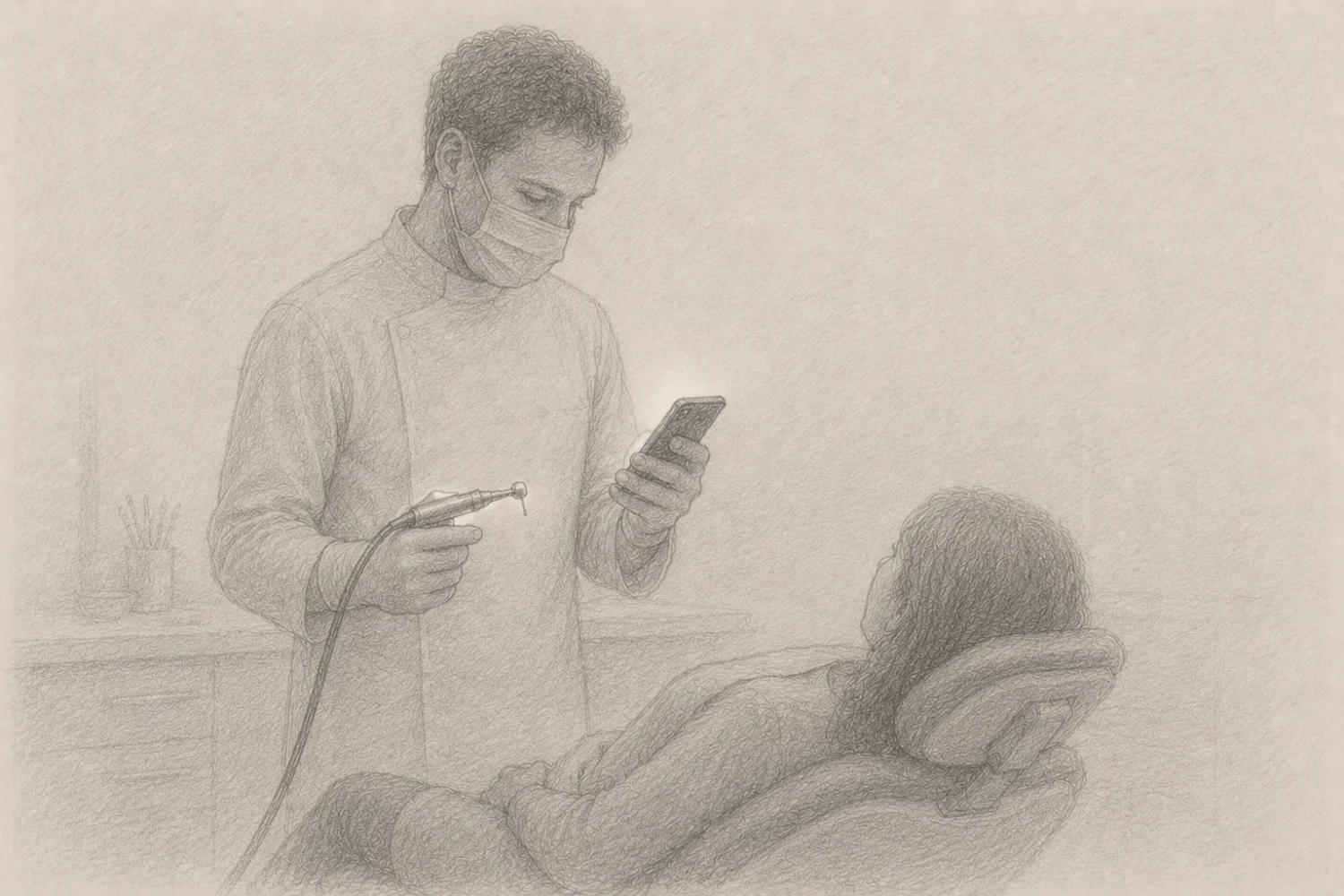
The other day, mid-session, I asked a client something. Would it be alright if I answered a Teams chat and an email on the side while we talked? He found that inappropriate. Then I asked how he would feel if his dentist glanced at his phone with the drill in his hand. He did not have to think long. My final question was the decisive one: what is the difference to your own work? Why do you accept being interrupted there, by people and by messages?
It went quiet.
Full attention, but only for others
We take undivided attention for granted when others owe it to us, at the dentist, from the pilot, from the surgeon. In our own leadership work the constant interruption counts as normal, almost as a mark of importance.
The research is clear. Gloria Mark at the University of California, Irvine has measured that after an interruption it takes on average about 23 minutes to return to the original level of concentration. Sophie Leroy names the reason "attention residue": part of our cognitive activity stays attached to the previous task, even after we have moved on. A brief glance at the phone therefore costs far more than the few seconds it seems to take.
The real point: the hand on the phone is your own
The real point comes next. Almost half of our interruptions we cause ourselves. It is our own hand that reaches for the phone, our own eye that drifts to the inbox. That places the topic squarely inside your circle of influence. Over the colleague who bursts in you have little power. Over the reflex to reach for the screen you have a great deal.
I have described the logic of the circle of influence more fully elsewhere, in When the job wobbles. Here the basic figure is enough: whoever asks what is actually in their hands usually finds more than they first suspected.
Three moves from practice
From this insight we put a few very concrete things in place with the client:
- Outlook opens straight in the calendar view in the morning, so the first look of the day belongs to his own planning.
- Mails on which he is only in copy are pre-sorted by an assistant; they are reviewed together in a fixed CC hour on Friday.
- In the morning he marks the frog on his to-do list, the most unpleasant task, and tackles it first.
These are small moves. They work because a stance sits behind them: that your own attention is a resource that deserves protection.
An impulse for your week
From your dentist you expect the drill to be put down before he looks at his phone. Your own work, and the people who depend on it, deserve the same undivided concentration.
Ask yourself once a day this week: which interruption did I just cause myself, and could it have waited ten minutes?
Frequently asked questions
- What is the dentist test?
- A simple question from coaching: would it be alright if your dentist glanced at his phone with the drill in his hand? The immediate answer is no. The test transfers that clarity to your own leadership work and makes visible how naturally we accept interruptions where we would demand full concentration from others.
- What is Gloria Mark's 23-minute rule?
- Gloria Mark at the University of California, Irvine measured that after an interruption it takes on average about 23 minutes to return to the original level of concentration. A brief glance at the phone therefore costs far more than the few seconds it appears to take.
- What does Sophie Leroy mean by "attention residue"?
- Sophie Leroy has shown that part of our cognitive activity stays attached to the previous task, even after we have moved on. This residue explains why switching tasks costs quality even when the interruption itself only lasted a minute.
- What can I change tomorrow?
- Three moves from practice: open Outlook straight in the calendar view in the morning so the first look of the day belongs to your own planning. Have an assistant pre-sort CC mails and review them in a fixed CC hour on Friday. And tackle the most unpleasant task ("the frog") first thing in the morning.
Want to read this offline or share it?
Related posts
Reclaiming the Circle of Influence in a Job Search
After years of responsibility, waiting for a reply means checking your inbox constantly. Covey's Circle of Influence and three clear axes of package, location and content give the ground back.
Temporary Exit: Stress and Old Patterns
On the motorway of habit, the temporary exit from coaching, and the four stages of real change: why new behaviour is first noticed only in hindsight before it eventually arrives on time.