Temporary Exit: Stress and Old Patterns
On the motorway of habit, the temporary exit from coaching, and the four stages of real change: why new behaviour is first noticed only in hindsight before it eventually arrives on time.
A client comes into the session a little dissatisfied with herself. In coaching she had set out to react differently in conflict situations. We had practised together how she could use the triple buffer: a brief inner pause before a reaction follows. Breathe, neutralise, ask a question. She knows it does her good. She knows the principle. And then, mid-conversation, when her counterpart says something that feels like an attack, it is all gone. No pause. No technique. Just the old, fast reaction.
How could that happen?
The motorway of habit
Our nervous system loves efficiency. Anything we have done often enough becomes a kind of inner motorway: a wide, well-built route on which stimulus and reaction follow each other within fractions of a second. Someone says something hurtful, and we accelerate. The emotion fires, the familiar thought follows, the habitual response is already on our lips.
In my article First the thought, then the feeling I describe the mechanics behind this: between every event and our feeling lies a thought, often so quick and automatic that we do not notice it. René Diekstra calls this, in the 5G model, the step from Gebeurtenis (the event) to Gedachte (the thought). On the motorway of habit these steps merge into a single reflex. The thought becomes so familiar that it turns invisible.
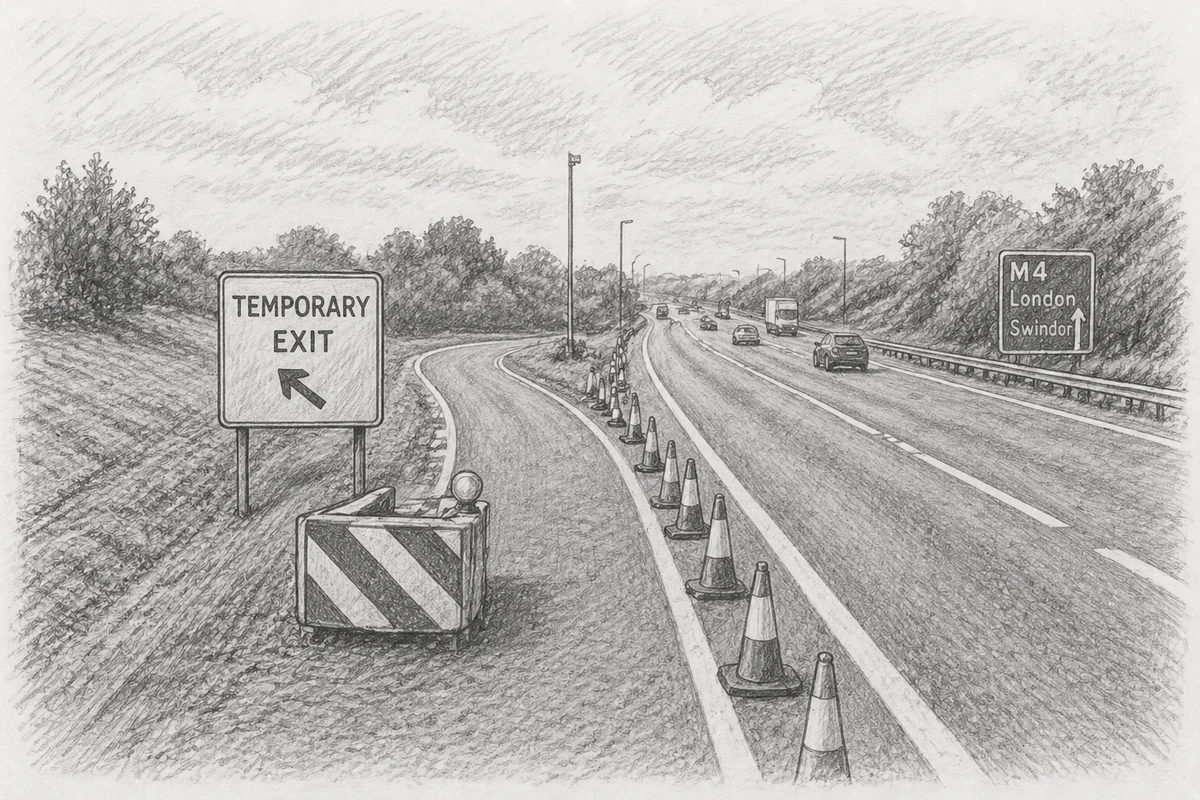
On this motorway we drive fast. Far too fast to notice a small, barely visible temporary exit that we have built in coaching.
This exit is new. It is narrow. And it lies a little before the point at which we normally switch to autopilot. Whoever races past at high speed does not see it, or only sees it long after the fact. You glance briefly in the mirror and think: ah, that's where it was.
Driving past is not failure
Here lies a misunderstanding I get to dissolve again and again in coaching: driving past the new exit does not mean that the coaching is not working. It means that the brain is still consolidating new neural connections. That takes time, repetition, and above all the conscious noticing of the moment afterwards.
Because at some point – and this is a real turning point – you drive past, look in the mirror, and think: there it was. The exit. This time too I did not take it. But I saw it.
That is exactly where real change begins.
The four stages of learning
What happens here is described by the four classical stages of competence, which go back to the American psychologist Noel Burch. In my article Why I did my coaching training twice I describe these stages from my own experience. In the context of the motorway metaphor they show up like this:
At the beginning stands unconscious incompetence. We do not know that we are showing a particular reaction, and we do not know that it could be otherwise. The motorway exists, but we do not even know it as a motorway. It is simply the only road we know.
In coaching this shifts. We become consciously incompetent: we recognise the pattern, we understand the mechanism, we have an idea of how it could be different. But under stress the knowledge is not yet anchored deeply enough to be called up spontaneously. We see the temporary exit only in retrospect. That is exactly what happened to my client, and it is the most normal step in the learning process.
With growing practice conscious competence emerges. We notice the trigger early enough, pause, choose deliberately. The exit gets wider. Sometimes we take it. Then more and more often. It still costs effort, but it works. In the triple buffer this is the moment when the conscious breath actually happens before the reaction follows.
And finally, after many repetitions, after real situations, after setbacks and new attempts, the temporary exit becomes a wide off-ramp. And eventually the main road. The new behaviour has become so familiar that it no longer requires a conscious decision. Unconscious competence. The old motorway? It lies fallow. Grass grows through the asphalt. Trees reclaim the terrain.
What leaders can take from this
This mechanic applies to every behavioural change in a leadership role. To the leader who learns to delegate instead of doing everything herself. To the manager who practises asking questions in meetings instead of giving answers. To the CEO who tries to pause in a crisis instead of deciding reflexively, as I describe in my article on negative capability.
In my article on the maturity model I describe why leaders often use only a single leadership style, usually delegating, because it is the most comfortable. The motorway metaphor explains why: the habitual style is the wide route. Choosing a different style, directing or participating instead of delegating, is the temporary exit that only becomes the new habit through deliberate practice.
No one changes their reaction pattern by thinking about it once. No one builds a new neural road through a single decision. What counts is the noticing: first only in hindsight, then earlier and earlier, until you finally brake in time.
And when the exit is missed again?
When my client comes into the next session and says she has missed the temporary exit again, I tell her: good. That means it exists. And that you saw it, even if only afterwards. Next time it will appear in your field of vision a few metres earlier. Until one day you know from far off: there is my exit. I'm turning off.
Whoever has missed the temporary exit knows that it exists. And sees it a few metres earlier the next time.
Further reading
- Four stages of competence by Noel Burch (Wikipedia) – The learning model behind the emergency-exit metaphor.
Frequently asked questions
- Why do we forget under stress what we learned in coaching?
- Practised reactions are wired into the nervous system as wide, fast routes. New behaviour is initially only a narrow temporary exit that becomes visible through repetition and eventually grows into the new main road. Driving past the exit is not failure, but a normal step in the learning process.
- What are Noel Burch's four stages of competence?
- Unconscious incompetence, conscious incompetence, conscious competence, and unconscious competence. Behaviour change rarely runs in a straight line – it moves in waves through these stages. Knowing them helps to read setbacks as way stations rather than as failure.
- How do I know that something is changing?
- By the fact that the old reaction still happens, but is noticed afterwards – with the thought: 'That's where the exit was.' This very moment of noticing is the turning point. Next time, the exit appears in your field of vision a few metres earlier.
Want to read this offline or share it?
Related posts
From “I want to" to “One should"
How we disempower ourselves in conversation with ourselves without noticing it, and how a single word decides between effectiveness and presence in a leadership role.
The Dentist Test
At the dentist we take undivided focus for granted. Almost half of our own interruptions we cause ourselves. A field report on focus as a leadership discipline, with Gloria Mark's 23-minute rule, Sophie Leroy's attention residue, and three very concrete moves from a coaching session.