Coaching Training: Why I Did It Twice
On the difference between knowing and being able, and why I went through the four stages of learning.
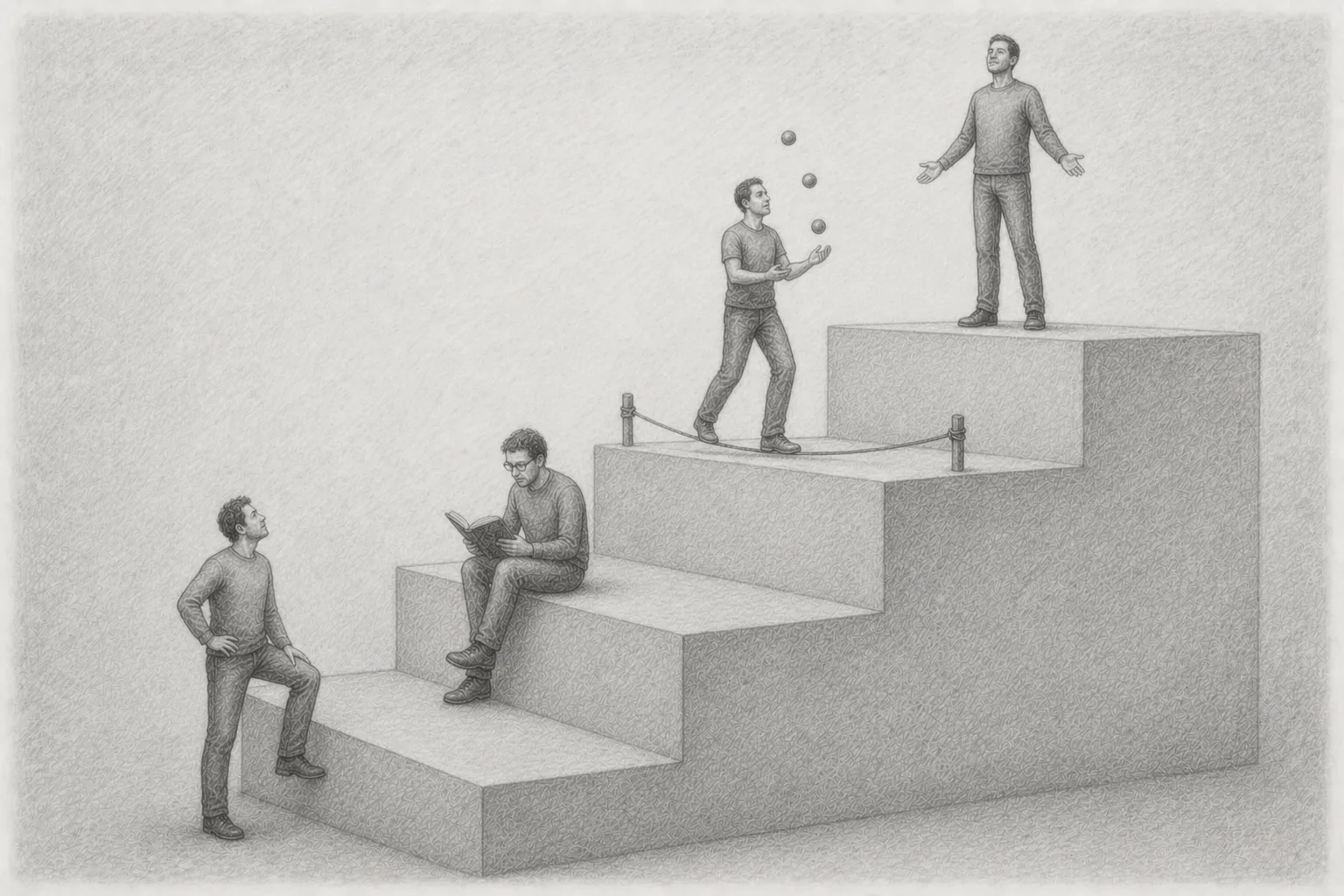
On the difference between knowing and being able, and why I went through the four stages of learning
In 2022, I completed my training as a systemic business and personal coach at the Coaching Akademie Berlin. It was an intense time. I learned a lot, reflected a lot, acquired a lot of knowledge. At the end of the training, I had a certificate, a collection of proven methods, and the conviction that I could now coach.
Then I started coaching.
And I realised: I can't really do it.
The difference between knowing and being able
The training included around 20 different coaching interventions, from more rational techniques such as timeline work and the Wheel of Life, to systemic questions, perspective changes and constellation formats, all the way to parts work, hypnocoaching and EFT. I had become familiar with all of them and tried them out within the protected setting of the training. The final exam was a live coaching session in front of the entire training group, a demanding form of assessment, but with one decisive limitation: you could choose the intervention yourself. To pass, it was enough to truly master a single method.
But when I sat in real coaching situations, with real clients and real concerns, something unexpected emerged: of those 20 interventions, I could perhaps reliably handle three or four. The rest was knowledge I knew, but not skill I could dependably call upon.
And here is a particularity of the coaching craft I had underestimated at the time: the need to master many techniques does not arise from the diversity of topics. In principle, almost any concern can be worked on with any method. The need arises from the diversity of people. Different clients have different affinities for how they are best reached. An analytical executive looking for clarity on priorities may benefit from structured timeline work. A client under inner pressure may only open up through parts work or a body-oriented method. Others again need the imagery of hypnotic language to come into contact with themselves.
But if I only really master three or four techniques, I can only optimally reach a fraction of clients. The others get what is available to me, not what suits them best.
That was an uncomfortable insight. It contradicted my self-image as a freshly trained coach. But it was unambiguous: when a situation called for a method that was not among my three or four reliable tools, I faced a choice. Either I awkwardly reached for my notes, breaking the flow of the session and stripping the process of its power. Or I stayed with what I could do confidently, and left aside possibilities that might have served the client better.
Neither felt right.
The decision to learn it again
I lived with this realisation for a few weeks. And then I made a decision some find unusual: I did the entire training again. In the form of a so-called Expert Level training, in which I went through the complete course a second time as a co-trainer for the next group.
That meant: every weekend, every module, every intervention again. This time, however, with a completely different lens. This time as someone who already knows what exists, and is now asking how to truly master it.
The difference was immense. In the first round, it was about understanding the methods. In the second round, it was about internalising them. Seeing how experienced coaches use them. Observing when they choose which intervention, and why. What had appeared to me in the first round as a tidy collection of tools turned out, in the second round, to be an interconnected whole, in which each method has its place and its specific conditions of application.
The four stages of learning
What I went through in this second round can be well described with a model from developmental psychology: the four stages of learning (also called the conscious competence ladder). The model goes back to Noel Burch of Gordon Training International, who developed it in the 1970s, and describes how people acquire new competencies.
Stage 1: Unconscious incompetence. I don't know what I don't know. Before I had even heard of the existence of systemic coaching methods, I couldn't miss them. This is the phase in which people often overestimate themselves, they don't know the depth of the field and have no idea what would even be possible.
Stage 2: Conscious incompetence. I know what I can't do. This is the uncomfortable phase after the first training. I had become familiar with 20 methods, and was painfully aware that I did not reliably master 16 of them. This phase is frustrating, but it is the beginning of real learning. You cannot improve anything you have not recognised as needing improvement.
Stage 3: Conscious competence. I can do it when I concentrate. In the second round, I reached this stage with more and more interventions. I could apply them, but I had to consciously think about when and how. My head was occupied with the method, not just with the client. This is an important stage, but it is not enough for good coaching. A client notices when the coach is cognitively wrestling with their technique instead of being present.
Stage 4: Unconscious competence. I can do it without thinking about it. The methods are so internalised that they are available by themselves at the right moment. I no longer need to consider which intervention fits which situation, it emerges from what the client says, from my perception, from what the moment calls for. The choice of intervention becomes intuitive. The questioning becomes intuitive. My attention is fully with the client, not with my own toolbox.
What this means for coaching practice
Today, after the second round and with more than 1,000 coaching sessions behind me, I dare to say: I can do it. Not in the sense of perfection, coaching is a craft in which you never finish learning. But in the sense of unconscious competence: the methods are available when the moment requires them, without me having to actively call them up.
For my clients, this means two things:
Presence instead of technique. When I no longer have to think about the method, I am fully with the client. I listen more closely, perceive more, am more flexible in my responses. That is the real difference between a coach who knows their craft and one who has mastered it.
Intuitive selection. The right intervention emerges from contact with the client. Sometimes a structured method like the Wheel of Life is the right fit. Sometimes a change of perspective. Sometimes work with inner parts. Sometimes a body-oriented or imagery-based intervention. The client gets what fits them.
What I take from this for my work with leaders
The experience of the second training has also changed me as a coach when I work with executives. There, I regularly encounter the stage of unconscious incompetence, people who step into new roles and don't know what they don't know. I see the frustration of conscious incompetence, when someone recognises what they still lack. And I see the relief when conscious competence finally turns into unconscious competence and leadership starts to feel natural.
The model helps in coaching conversations because it de-dramatises learning processes. Conscious incompetence feels like failure, but is, in truth, progress. Conscious competence feels like endless effort, but is the necessary precursor to sovereignty.
And perhaps one more insight that I myself only understood through the second round: there is no shortcut from Stage 1 to Stage 4. No method, no training, no talent in the world allows you to skip the toils of conscious competence. There is only the willingness to truly walk through the stages, or the illusion of already being able to.
I am glad that, back then, I chose the longer path.
Particularly relevant for
Want to read this offline or share it?
Related posts
Where we look last for answers
An old parable about inner peace meets a systemic principle: when something outside is stuck, the most reliable lever lies in our own state and our own behaviour.

Executive Coach with Leadership Experience
Why executive coaches need their own leadership experience: on systemic coaching, Schein's Process Consultation, and the conscious change of role.