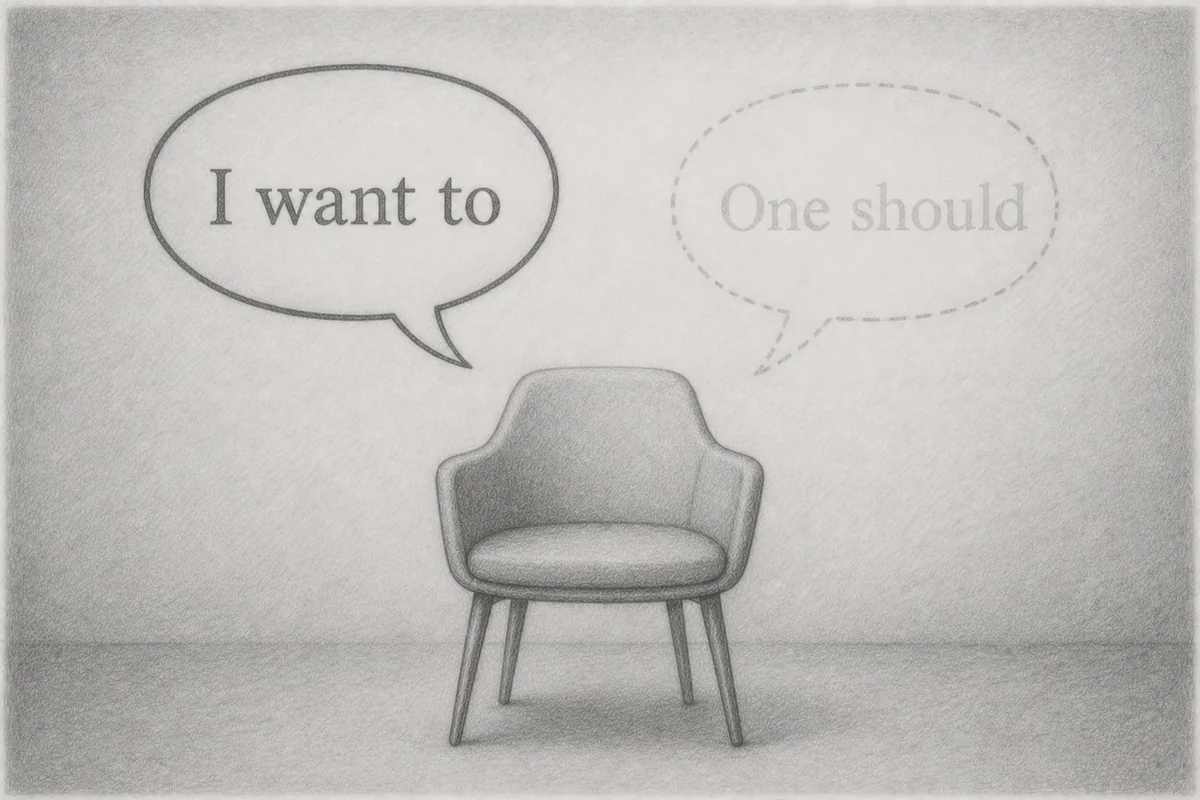
From “I want to" to “One should"
How we disempower ourselves in conversation with ourselves without noticing it, and how a single word decides between effectiveness and presence in a leadership role.
It happens in almost every coaching engagement at some point. We are talking about a topic that matters to the client. Things are moving forward, the energy is right, the person is present with themselves. And then, when it gets to the heart of the matter, when the consequence becomes visible, the change tangible, a switch happens. Not in content. In language.
A moment ago the client said: “I want to tell my boss more clearly what I need." A moment later: “One really should have a conversation about that."
At first glance it sounds like the same thought. At second glance it is a fundamental difference. And exactly this difference is often the key to the coaching outcome.
What is happening in that moment
When someone shifts from “I want to" to “one should", two things happen simultaneously, reinforcing each other.
The first is a dissociation. The “I" disappears and is replaced by “one". “One" is nobody. “One" is an abstract instance, a faceless collective that puts no one on the hook. The client steps out of their own concern and looks at it from the outside, as if it were someone else's problem. In the moment “I" turns into “one", the person is no longer the actor but the observer of their own life.
The second is a delegation. “Want to" is replaced by “should". “Want to" is a wish: something that comes from me, that belongs to me, for which I carry responsibility. “Should" is an instruction from outside, an abstract duty that comes from somewhere, but not from me. Whoever says “should" has handed over responsibility. To circumstances, to the expectations of others, to an inner voice that lays down rules nobody has questioned.
Together: “I want to" means: I am the subject of my life, I have a wish, and I am willing to do something about it. “One should" means: somebody, sometime, ought to do something. The probability that anything will happen drops dramatically in that moment.
What I do then
When I notice this shift in coaching, I mirror it. Not as analysis, but as experience. I model for the client how it feels when someone speaks to them the way they have just spoken to themselves.
I say: “You have to talk to your boss now. You have to set clearer boundaries. You have to position yourself better."
The reaction is the same every time: bewilderment. Resistance. Sometimes a laugh of recognition. No one wants to be addressed like that. No one responds to a “you have to" with motivation and drive. The natural reaction to coercion is resistance, even when the coercion comes from within.
And that is exactly the point: many people are so used to talking to themselves with little compassion that they no longer notice it. The inner dialogue is full of “you have to", “one should", “it would be the very least": a constant stream of instructions, judgments and reproaches that they would never inflict on a friend. But on themselves, yes.
A sentence that makes the difference
There is a sentence I like to use in such moments. It comes from the book 50 Sentences That Make Life Easier by Karin Kuschik, a German bestseller that takes aim at exactly this place:
“Wanting is just like having to, only voluntary."
The sentence sounds at first like a play on words. But it contains a deep truth about motivation and self-leadership. Whoever wants something acts from their own drive. Whoever has to do something acts under coercion. The result may look the same on the outside, but the inner posture is fundamentally different. And with it the energy, the endurance, and the joy with which one does something.
The shift from “I have to" to “I want to" is not a semantic trick. It is a decision about who is directing your own life.
The client who wanted to be more persuasive
A client, a middle manager, came to me with the goal of being more persuasive. In meetings, in presentations, in conversations with the board. He wanted to communicate more effectively, show more presence, push his ideas through.
In the first sessions I noticed that he had a particular way of speaking about himself and his situation. Again and again he switched from the first to the third person. “I think that..." became “one could..." and “it would make sense if..." His own wish, his own opinion, his own concern disappeared behind impersonal phrases.
That was his blind spot. He wanted to come across as more persuasive, but his language signalled exactly the opposite. Whoever says “one" instead of “I", whoever says “should" instead of “want to", does not show up as a personality but as a transmitter of generalities. No board lets itself be persuaded by someone who cannot even formulate his own position as his own position.
We worked over several sessions on changing his language, not with rhetorical exercises, but by becoming aware of what was happening internally in those moments. Why did he step out of the “I"? What was the fear behind it? Often it is the fear of being attackable when holding a clear position. “One should" is a shield: if it goes wrong, well, it wasn't my idea, it was just what “one" supposedly should do.
The work was to put down this shield, piece by piece. Not by telling him: “From now on always say I." But by helping him understand why he didn't and what he gains by doing it. Persuasion begins with standing behind what you think and want. And that begins with one word: I.
Three patterns I hear again and again
In my coaching I encounter three typical variants of this phenomenon.
The first is the shift from “I" to “one", the dissociation I described. It appears especially when the client senses that a change has uncomfortable consequences. “One" creates distance from one's own responsibility.
The second is the inner driver disguised as duty. “I have to deliver the project." “I have to be present in that meeting." “I have to give my team more feedback." In truth the person wants all of this, but frames it as coercion because they have learned that doing one's duty is more acceptable than expressing a personal wish. The result: feeling externally controlled in a life one is in fact shaping oneself.
The third is the lack of self-friendliness. Some clients speak to themselves in a tone they would never accept from a manager. “I should have known better." “Why can't I get this right?" “Other people manage it." This inner critic is not motivating, it is paralysing. And it is so familiar that most people don't even recognise it as such.
What leaders can take from this
The way we talk to ourselves shapes the way we show up in the world. A leader who internally jumps from “one should" to “one should" will show up the same way in meetings: vague, non-committal, hard to grasp. A leader who internally says “I want this, and this is the reason" shows up with a clarity others can sense before they have heard a single word.
This is not a rhetoric exercise. It is a shift in posture. And it begins with really listening to your own inner dialogue once and asking yourself: would I talk this way to a person I care about?
If the answer is no, it is time to change the language. Not the outer one, the inner one.
Further reading
- Self-Determination Theory (Deci & Ryan) – Research on autonomy as a prerequisite for intrinsic motivation.
- Karin Kuschik: 50 Sätze, die das Leben leichter machen (Rowohlt 2022) – No. 1 Spiegel bestseller, translated into more than 25 languages. Sentences that work exactly where our language gets in our way.
Frequently asked questions
- What does the shift from “I” to “one” mean psychologically?
- It is a dissociation: the “I” as subject disappears, “one” is nobody. People who say “one” step out of their own concern and observe it from the outside – as if it were someone else's problem. They are no longer the actor, but the observer of their own life.
- Why is “Wanting is just like having to, only voluntary” so effective?
- The phrase from Karin Kuschik's book makes the point: “having to” delegates responsibility to an outside force, “wanting” keeps it with me. The outer result may be the same – but the energy, endurance and joy in doing it differ fundamentally.
- How does inner dialogue affect leadership impact?
- A leader who internally says “one should” will show up in meetings the same way – vague, non-committal, hard to grasp. A leader who internally says “I want this, and this is the reason” radiates a clarity that others feel before a single word is spoken. Language shapes posture, and posture shapes impact.
Particularly relevant for
Want to read this offline or share it?
Related posts
Temporary Exit: Stress and Old Patterns
On the motorway of habit, the temporary exit from coaching, and the four stages of real change: why new behaviour is first noticed only in hindsight before it eventually arrives on time.

The Dentist Test
At the dentist we take undivided focus for granted. Almost half of our own interruptions we cause ourselves. A field report on focus as a leadership discipline, with Gloria Mark's 23-minute rule, Sophie Leroy's attention residue, and three very concrete moves from a coaching session.