The Peter Principle: Why nobody steps back
On Laurence J. Peter's principle, the three invisible costs of stepping back from a promotion (financial, inside the company, and at home), and why the real problem is not the person but the system.
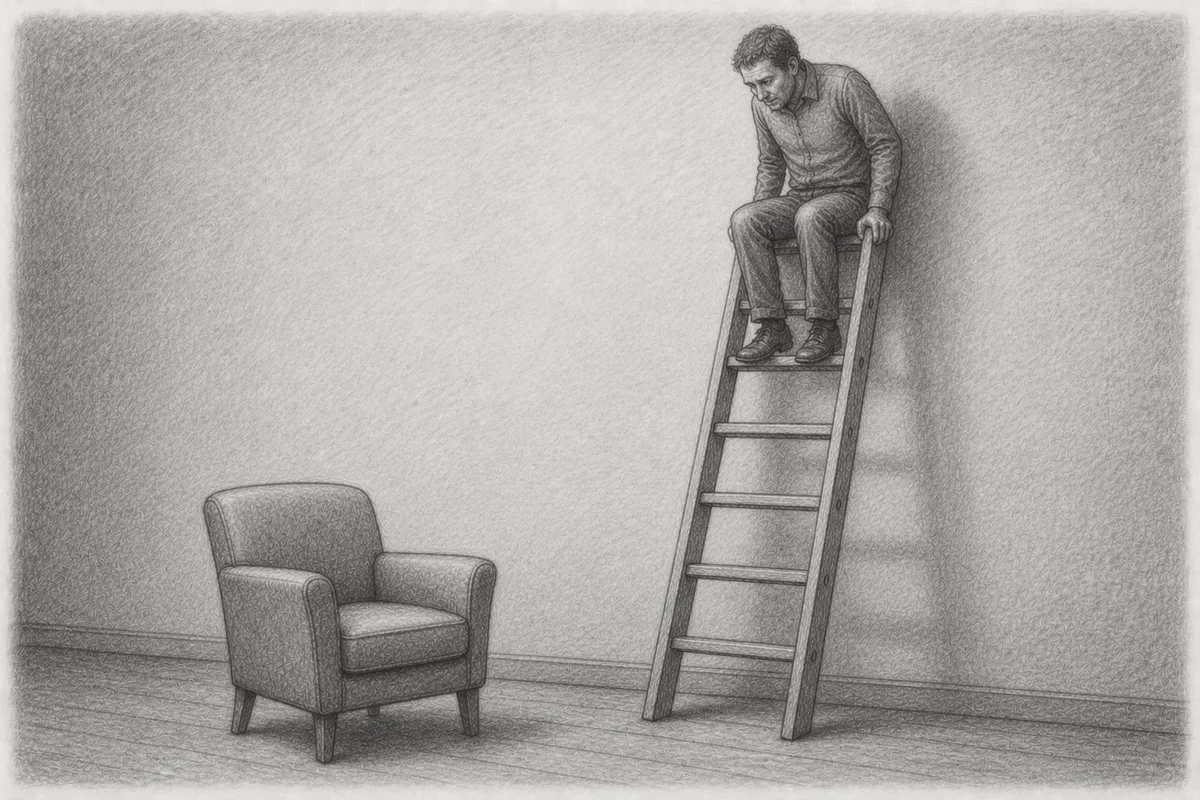
There is a phenomenon in companies that almost everyone knows but surprisingly few name out loud: people are promoted until they reach a position in which they are no longer successful. They struggle there because the role demands something different from what got them there.
Canadian psychologist Laurence J. Peter described this phenomenon in the late 1960s and sharpened it with an observation that remains uncomfortable today: in hierarchies, every employee tends to rise to their level of incompetence. Peter put it this way: after a certain time, every position is filled by an employee who is unable to perform their duties.
That sounds cynical. It is, a little. But before getting hung up on the wording, it is worth looking more closely. At its core, the Peter Principle describes a system failure that is too often blamed on individuals.
It is never just the person
Before I get into the mechanics, I want to emphasise something that matters to me as a coach: it is never the person alone who “fails". It is always the combination of role and person that does not produce the desired results. Throughout my own career in international corporations I have seen again and again what can happen when someone who did not work in one role moves into another and suddenly thrives.
This happens more often than people assume; it is more the rule than the exception. So the question is not whether a person is competent, but whether the role matches what they bring.
How a “Peter" emerges
The mechanics are simple and easy to follow: a specialist delivers excellent work for years. At some point, both for the person and for the organisation, the question of more responsibility comes up. A promotion. More budget, more people, bigger projects, higher revenue.
In many cases the trust turns out to be justified. The person grows into the new role. But at some point, at a different point for every person, there comes a promotion in which the new requirements demand fundamentally different competencies than before.
The classic case: a recognised technical expert, the department's best analyst, the team's most brilliant engineer, is suddenly supposed to lead a team. Technically, there are no questions. But leading a team of analysts is a completely different competency than being the best analyst yourself. Motivating, developing people, mediating conflicts, setting priorities, delegating: none of this has much to do with the technical excellence that led to the promotion.
When it then does not work out, a situation arises that is hard on everyone. The leader feels they are hitting their limits. The team notices. Results decline.
The three costs no one names
And here begins the real problem. It is less the wrong placement itself than the fact that there is almost never a way back. In my entire career I have only very rarely seen a leader return to their previous role inside the same company. The reason does not lie in the organisation. It lies in three kinds of cost that together build an invisible wall.
The first layer is financial. A promotion almost always comes with a pay rise. Stepping back means earning less, at a stage in life when financial commitments have grown.
The second layer is the perception inside the company. Someone who was promoted and then steps down is, fairly or not, seen as having failed. In most corporate cultures, this is a stigma you cannot shake off.
The third layer is the least discussed and often the heaviest: perception at home. Partner, family, and social circle all celebrated the promotion. A step back is not just a professional admission; it touches identity.
The Peter Principle is so persistent because a step back triggers all three costs at once. And because most people, understandably, would rather stay in a role that does not fit than pay this triple price.
What organisations can do
I have seen exactly one company in my career that solved this problem wisely. Promotions there came with a trial period, without an immediate salary adjustment. The person could try out the new role. If it worked, the step was formalised. If not, they could return to their previous role without losing face.
That sounds simple. But it changes the whole dynamic: the promotion becomes an experiment rather than a one-way climb. Pressure drops. Honesty rises. And the organisation gets better information about whether someone really thrives in the new role, before the three costs make the wall insurmountable.
I regularly recommend this model to HR departments. And also to confident emerging leaders eyeing the next career step: seeing a leader's chair is not the same as having to make decisions from it.
What coaching can offer here
As a coach, I meet both sides of the Peter Principle. People who sense that their current role no longer fits and do not know how to change that without paying the three costs. And people facing a promotion who are unsure whether they are equal to the new role.
In both cases it is not about competence in the classical sense. It is about fit. About the honest question: what can I do, what do I want, and what does this role really demand? Not the polished job description, but the actual day-to-day in that position.
Coaching can offer a space that rarely exists inside the organisation: a space in which these questions can be asked honestly, without the answer immediately having consequences. A space in which “I am not sure this is the right role for me" is not an admission of weakness but a sign of maturity.
A word on Peter and Petra
Laurence Peter named his principle after himself. But there is a reason why “Peter" is more accurate than “Petra", and it is not the discoverer's name. It is still more often men who confidently aim for the next career step without sufficiently checking whether the new role actually fits them. Women, by contrast, often sell themselves short, a phenomenon known as the Paula Principle. They could often handle the new tasks but hesitate, because they do not want to become a “Peter" under any circumstances.
Perhaps this hesitation is sometimes wiser than it looks at first glance.
My takeaway
Laurence Peter ends his book with the rather provocative advice that you might be better off using your energy to avoid a career altogether. I cannot follow him there. But I would put it like this: a career inside a company works best when you do not want it too badly. As long as you do what you can and what brings you joy, and keep your inner independence, career steps can be the natural consequence. I would advise against treating them as an end in themselves.
Because then you lose your self-criticism. And without self-criticism, anyone eventually becomes a Peter.
Further reading
- Laurence J. Peter & Raymond Hull: The Peter Principle (William Morrow 1969) – Original source on the mechanics of promotions in hierarchies.
- My book Peter mag keinen Frosch zum Frühstück (Amazon) – This article is based on a chapter from it.
Frequently asked questions
- What is the Peter Principle?
- Canadian psychologist Laurence J. Peter described in the late 1960s how, in hierarchies, employees tend to rise to their level of incompetence. Eventually every position is filled by someone who can no longer meet its demands. The cause is rarely personal failure; usually the new role requires fundamentally different competencies than the previous one.
- Why do leaders almost never return to their previous role?
- Three costs build an invisible wall: a lower salary, the stigma of being seen as “failed” inside the company, and – often the heaviest – the perception at home, where partner and family celebrated the promotion. Most people would rather stay in a role that does not fit than pay this triple price.
- What can organisations do about the Peter Principle?
- One proven solution: link promotions to a trial period without an immediate salary increase. If the new role works out, the step is formalised. If not, the person can return to the previous role without losing face. This changes the whole dynamic: promotion becomes an experiment instead of a one-way street.
Particularly relevant for
Want to read this offline or share it?
Related posts
Corporate Careers: Grass Grows in Its Time
On Stephen Covey's Circle of Influence, Deci and Ryan's Self-Determination Theory, and the difference between worry-bearers and shapers in corporate careers.
Why I No Longer Steal Problems: My Path
830 kilometres on the Camino de Santiago and a single sentence from a Dutch pilgrim shifted my view of leadership and helping, and why good leadership means leaving the problem with the other person.