Emotional Bank Account: Build a Balance
On Stephen Covey's image of the emotional bank account, Management by Walking Around, and why remote leaders in particular need time without an agenda for their teams, because otherwise every demand becomes a withdrawal from an empty account.
A while ago I had a coaching session with a client who was in Asia at the time. She leads a team there that she only sees in person a few times a year. We spoke by video, as always.
She described a stretch with many parallel projects and several new people on the team. We came to talk about her leadership stance, and the question of how much coach is in a good leader. The coaching stance: listening, observing, asking the right questions instead of jumping to answers. Out of that conversation came an insight that surprised her: “I really should be asking many more questions. I don''t actually know where my new people stand."
Then came the next step. To ask the right questions, she needed time with her people. Not the kind of time that shows up in the calendar as a “project update". Time without an agenda. And suddenly we were at the question that runs through this entire piece: how much time do you spend with your team without a project goal on the table?
She realised that she filled the bulk of her on-site days with operational matters: project lists, emails, deadlines. All of which she could just as well have done from home. The few days a year she was physically present with her team were not reserved for what is only possible on-site: relationship.
Stephen Covey''s metaphor
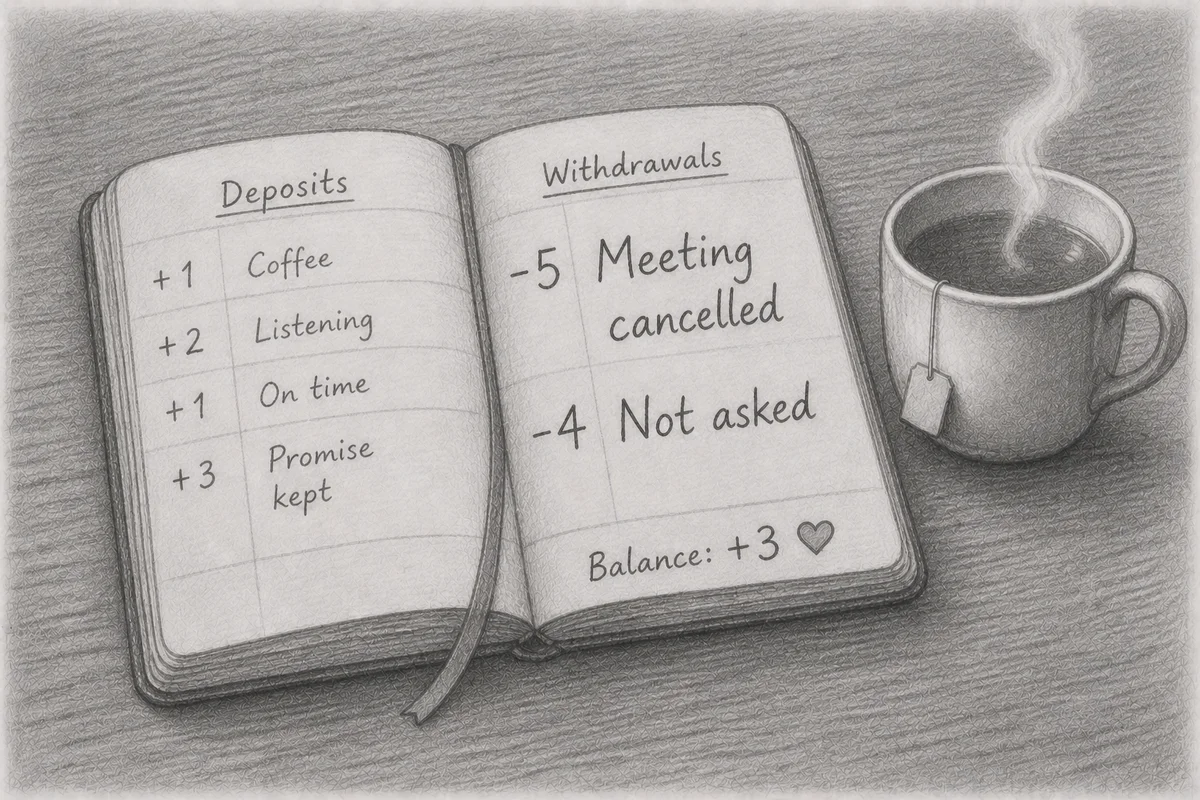
In The 7 Habits of Highly Effective People, Stephen Covey coined an image that captures this dynamic: the emotional bank account. The idea is disarmingly simple. Between every person and every other person they regularly interact with, there is a kind of invisible account. Deposits are kindness, reliability, attention, kept promises, real listening. Withdrawals are broken commitments, disrespect, being ignored, lack of appreciation.
Whoever deposits regularly builds a balance. And that balance is the foundation for everything leadership rests on: trust. A leader with a high balance can make difficult decisions, speak uncomfortable truths, demand performance, without the relationship breaking. Because the account can sustain it. Because there is enough credit to absorb a withdrawal.
A leader with an overdrawn account does not have that latitude. Every critical piece of feedback, every additional demand, every decision that affects the team feels like another attack. Because there is no balance to cushion the blow.
What depositing means
Covey describes six ways to make deposits into the emotional bank account. Genuinely seeking to understand the other person. Attending to the little things. Keeping commitments. Clarifying expectations. Demonstrating personal integrity. And apologising sincerely when you have made a withdrawal.
In my coaching practice I find that most leaders would sign off on these points in theory. The problem is rarely knowledge. It is the day-to-day. Operational urgency systematically crowds out relational work. The project call is in the calendar; the coffee with the team member is not. The quarterly review has a deadline; the personal conversation does not. And so week after week passes in which the account is not topped up while withdrawals continue: a curt email here, a cancelled one-on-one there, a decision made without consultation.
Management by Walking Around
In In Search of Excellence (1982), Tom Peters and Robert Waterman coined a term that addresses precisely this mechanism: Management by Walking Around (MBWA). The idea: leaders should regularly walk through the organisation, talk with people, listen, be visible. Not as a control round, but as an investment in relationship.
The label sounds dated. The mechanism behind it is not. Every walk through the office, every brief chat by the coffee machine, every question about the weekend is a deposit into the emotional bank account. Small amounts that add up to a substantial balance over time.
In my piece on loss aversion as described by Kahneman and Tversky, I describe how people feel losses about twice as strongly as equivalent gains. For the emotional bank account this means: one broken commitment weighs more than two kept promises. A cancelled conversation counts more than three meetings on time. Withdrawals are more expensive than deposits. Which makes regular depositing all the more important – you need a buffer for the inevitable moments when you withdraw.
The Asia trip: a missed opportunity
Back to my client. Her situation is exemplary of a pattern I see in many leaders running international teams. The few days on-site are precious. And precisely because they are precious, you pack them with operational items, because you feel you have to use the time “productively".
The opposite is true. The most productive investment a leader can make on a business trip to her remote team is time without an agenda. Going for a meal together. Having a coffee. Asking how the kids are. Listening to what moves people, beyond the project list.
These are not soft skills. These are deposits into the emotional bank account. And without that balance, every operational demand, every critical piece of feedback and every difficult decision she makes from Berlin becomes a withdrawal from an empty account.
We ended that day''s coaching session a little early. She felt the energy to change something immediately. Her plan: make herself a tea in the kitchenette and see who was around. No agenda, no occasion. Just be there. I think it was the most effective coaching session in a long time. Not because of what I said, but because of what she did afterwards.
Why it is hard
In my piece on the Circle of Influence I describe how leaders should focus their energy on what they can actually influence. The emotional bank account lies entirely within one''s own sphere of influence. Nothing prevents a leader from having a coffee with a team member on Monday morning. Nothing forbids ending a meeting five minutes early to ask about the person rather than the project.
And yet many leaders find it hard. The reason often lies in what I describe in my piece on the maturity model: leaders who themselves operate at a high maturity level forget that their people need not only technical guidance, but also emotional attention. The R4 trap – the reflex to delegate everything and step back – is also a trap for the emotional bank account. Delegation without relationship work dries the account out.
You cannot lead a team on overdrawn accounts
The consequence is clear. A leader whose emotional bank accounts with team members are overdrawn has no leadership effect left. She can give orders, but no one will follow voluntarily. She can give feedback, but it will be felt as an attack. She can initiate change, but she will meet resistance that has less to do with the change itself than with a missing trust in the person demanding it.
Covey''s six types of deposit cost no money. They cost time and attention. In a working world that treats both as scarce resources, the deliberate investment in emotional bank accounts is a leadership decision. Possibly the most important one to make on a Monday morning.
Further reading
- FranklinCovey: The 7 Habits of Highly Effective People – Official source on the Emotional Bank Account concept (Habit 4).
- Stephen R. Covey: The 7 Habits of Highly Effective People (Free Press 1989) – The original work; the Emotional Bank Account stems from Habit 4.
- Tom Peters & Robert H. Waterman: In Search of Excellence (Harper & Row 1982) – Source for "Management by Walking Around".
Frequently asked questions
- What is Stephen Covey's emotional bank account?
- In “The 7 Habits of Highly Effective People", Stephen Covey describes the emotional bank account as a metaphor for the trust between two people. Deposits are reliability, true listening, kept promises and small acts of attention. Withdrawals are broken commitments, disrespect or being ignored. Whoever deposits regularly builds the balance that leadership rests on.
- Why do withdrawals weigh more than deposits?
- Loss aversion, as shown by Kahneman and Tversky, means losses feel about twice as heavy as equivalent gains. Applied to the emotional bank account: a single broken commitment cancels out the effect of several kept promises. That is why a continuous buffer of small deposits matters – so the inevitable withdrawals do not overdraw the relationship.
- How do I actually deposit into the emotional bank account?
- Covey lists six ways: seek to truly understand the other, attend to the small things, keep promises, clarify expectations, show personal integrity, and apologise sincerely after a withdrawal. In day-to-day leadership this means above all: time without an agenda. The Monday coffee, the conversation beyond the project list, the question about the person rather than the task.
Want to read this offline or share it?
Related posts
Corporate Careers: Grass Grows in Its Time
On Stephen Covey's Circle of Influence, Deci and Ryan's Self-Determination Theory, and the difference between worry-bearers and shapers in corporate careers.

Where we look last for answers
An old parable about inner peace meets a systemic principle: when something outside is stuck, the most reliable lever lies in our own state and our own behaviour.