Johari Window: Blind Spots in Leadership
The Johari Window in executive coaching: how leaders spot blind spots and façades before they crack under pressure, authenticity as a lever.

Why authenticity isn't a choice, but a necessity
In my work with young leaders, I encounter a pattern so common it has almost become standard: someone takes on a leadership role for the first time and builds, consciously or unconsciously, an image of how a leader is supposed to be. That image is often shaped by role models, organisational expectations, or popular notions of leadership. What emerges is, more often than not, a façade.
I don't mean that young leaders deliberately deceive. I mean they show a version of themselves they consider appropriate, and hide another version they believe doesn't fit the role. That's human. And it's a problem.
The Johari Window: A model for self- and other-perception
To understand why façades don't work in leadership, a model from social psychology helps: the Johari Window. It was developed in 1955 by the American psychologists Joseph Luft and Harry Ingham, the name "Johari" combines their first names.
The model divides what is known about a person into four quadrants, based on two questions: What do I know about myself? And what do others know about me?
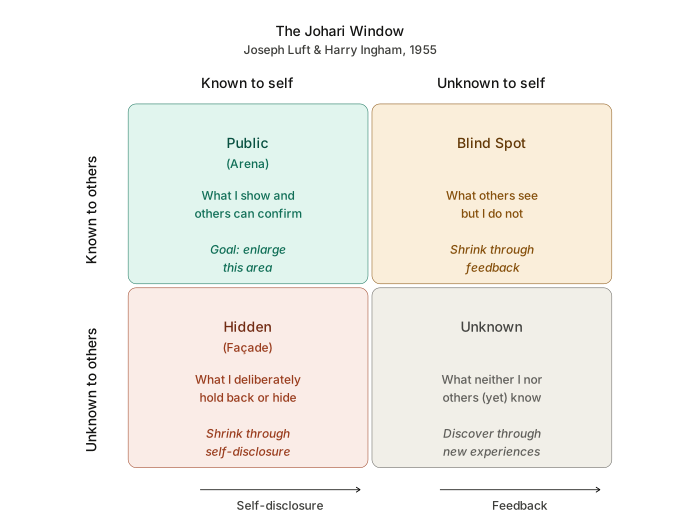
The public area (top left) contains everything known to both me and the people around me: my communication style, my obvious strengths, my visible behaviour.
The blind spot (top right) contains what others perceive in me but I do not see myself: a habit in meetings, a tone of voice under stress, an effect I don't intend.
The hidden area (bottom left), and this is where it gets interesting for leadership, contains everything I know about myself but deliberately hold back. My insecurities, my doubts, my personal convictions. This is the area of the façade.
The unknown area (bottom right) contains what is conscious neither to me nor to others, unconscious patterns, hidden potential, deep-seated influences.
The goal of healthy communication and good leadership is to enlarge the public area, through feedback (which shrinks the blind spot) and through self-disclosure (which shrinks the hidden area).
A façade is not discretion
An important distinction: not everything has to be shared. Of course there are things that may and should remain private at work. My personal worries, my relationship, my health, in most cases that's none of my team's business. That's not a façade. That's healthy discretion.
A façade arises when I actively construct an image of myself that doesn't match who I am. When I project confidence in a meeting that I don't feel. When I voice an opinion that isn't mine. When I play a role that doesn't fit my personality.
The difference is: discretion means not showing certain things. A façade means showing something other than what is.
What happens when the façade breaks
As long as pressure is moderate, a façade can be maintained. But leadership means pressure, and at some point the strain becomes so great that the façade no longer holds. A conflict escalates. A deadline becomes untenable. A difficult conversation goes off the rails.
In that moment, the team sees a different person from the one they thought they knew. And that's exactly the problem: not the emotion itself, but the discrepancy. Team members ask themselves: who am I actually dealing with? Was any of this real? Can I trust this person?
Trust is based on predictability. We trust people whose behaviour we can anticipate. When a leader normally appears composed and controlled but suddenly reacts aggressively or helplessly under pressure, an unease arises that runs deeper than the individual situation. The team doesn't lose trust in the leader's competence, it loses trust in the person.
The 93-percent reality
There is a much-cited insight from communication research: a substantial part of the information we send to others is conveyed not through words, but through body language, tone of voice and facial expression. The often-quoted figure of 93 percent non-verbal communication goes back to studies by Albert Mehrabian and is today viewed in a more nuanced way. But the core holds: we communicate far more than we are aware of.
What does this mean for the façade? That it's leaky, even if we don't notice. We're not professional actors. Our body language, our micro-expressions, our vocal colour constantly betray what's happening behind the façade. Our team members pick up on it, often unconsciously, but they pick up on it. They sense when something doesn't add up. And that lack of coherence creates a diffuse unease that affects collaboration.
The only way: authenticity
If the façade isn't sustainable in the long run, if it breaks under pressure, if it's translucent through non-verbal signals anyway, then there is only one sustainable path: authenticity.
Authenticity in leadership doesn't mean saying everything you think. It doesn't mean airing your insecurities at every team meeting. It means: what I show is consistent with what is.
In the Johari Window, that means shrinking the hidden area where it has become a façade. Not disclosing everything, but no longer pretending.
This has concrete consequences for young leaders:
It means being able to admit when you don't know something, instead of simulating competence. It means aligning your leadership style with your own personality, instead of copying an ideal that doesn't fit. And it means being the same person under pressure as in normal conditions, because there is no second version waiting to surface.
That isn't easy. It requires self-knowledge, the courage to be vulnerable and the willingness to engage with your own blind spots. But it is the only path to leadership that people can trust over the long term.
What I see in my coaching
Working with the Johari Window, even if I don't always call it that, is a core part of my coaching practice. Many leaders come to me with the feeling that something is off, without being able to name it precisely. Often it turns out: they have built up a hidden area over years that costs more and more energy to maintain.
The work then isn't to disclose everything. It's to find out: what of this is healthy discretion, and what is a façade that drains me and unsettles my team?
The answer to that question is the beginning of authentic leadership.
Further reading
- Johari window (Wikipedia) – Background on the model by Joseph Luft and Harry Ingham (1955).
Particularly relevant for
Want to read this offline or share it?