Conflict Coaching: Thomas-Kilmann Model
Understanding and resolving conflict means looking beneath the waterline. How the iceberg and Thomas-Kilmann models dissolved hardened fronts in a law firm.
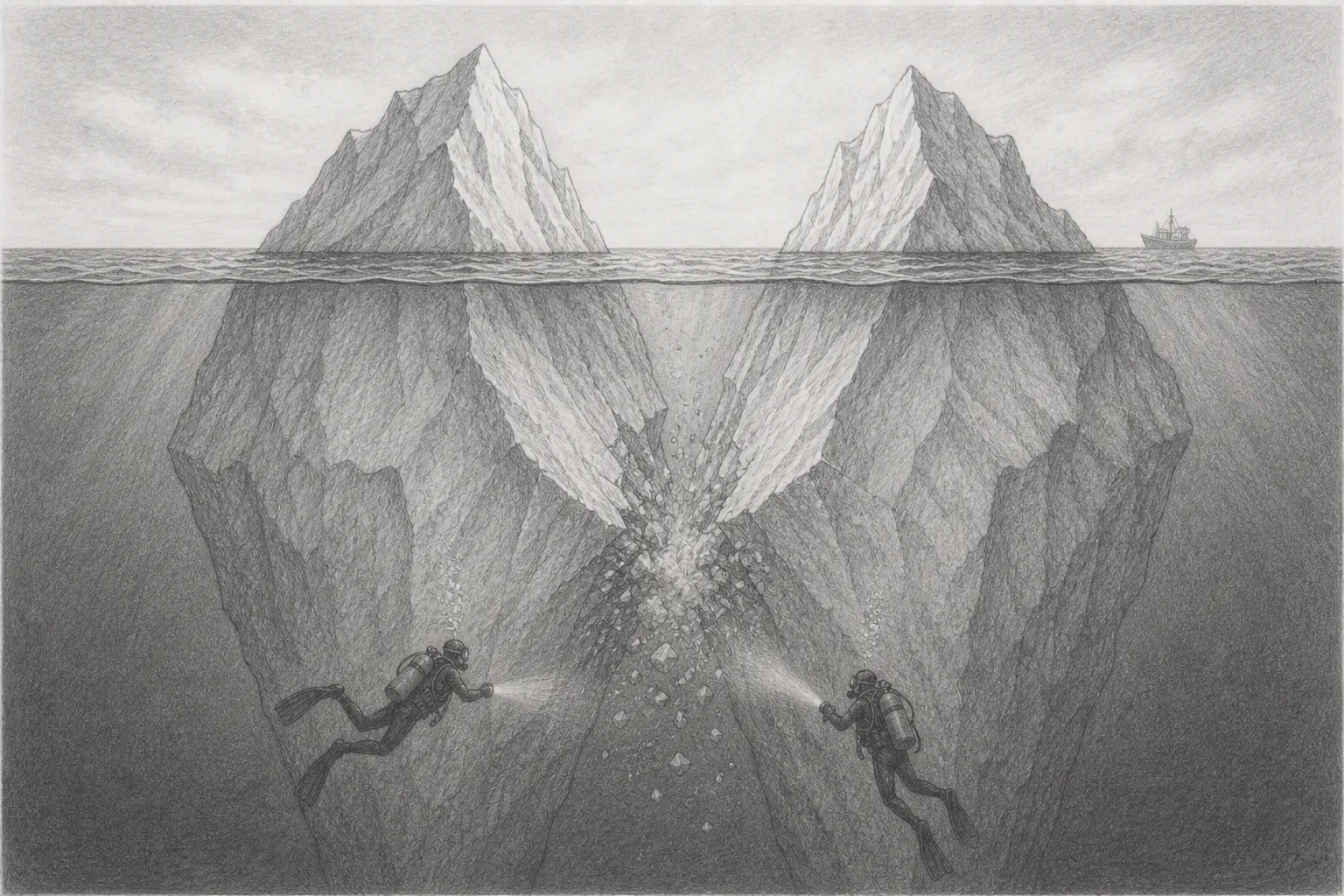
Some time ago I was commissioned to support the resolution of a conflict among the partners of a renowned law firm in southern Germany. What I experienced there reinforced a conviction that runs through all of my coaching work: conflicts are not solved at the level on which they are visible. They are solved when both sides understand what lies beneath the surface.
The Starting Point
Even during the round of introductions the tension was palpable, not only among the partners, but also towards me. This is not unusual in conflict coaching: anyone who has been in dispute for months is not immediately open to someone who comes from outside to moderate. There is mistrust, there is the question of whose side the coach is on, and there is the worry of showing oneself vulnerable in front of a stranger.
In such moments one thing is decisive: that I as a coach can act on equal footing. Senior partners of large firms are used to dominating rooms. They are trained in arguing positions and defending them. If in this constellation I were not able to enter the dialogue with composure and respect, but also clearly and directly, including on difficult themes, including in front of others, the workshop would not have worked.
The Thomas-Kilmann Model: Five Ways of Dealing with Conflict
To understand what happens in a partnership conflict, a model from conflict research helps: the Thomas-Kilmann model (TKI), developed by the psychologists Kenneth W. Thomas and Ralph H. Kilmann in the 1970s.
The model describes five fundamental conflict styles emerging from two dimensions: how strongly do I assert my own interests (assertiveness)? And how strongly do I take the other side's interests into account (cooperativeness)?
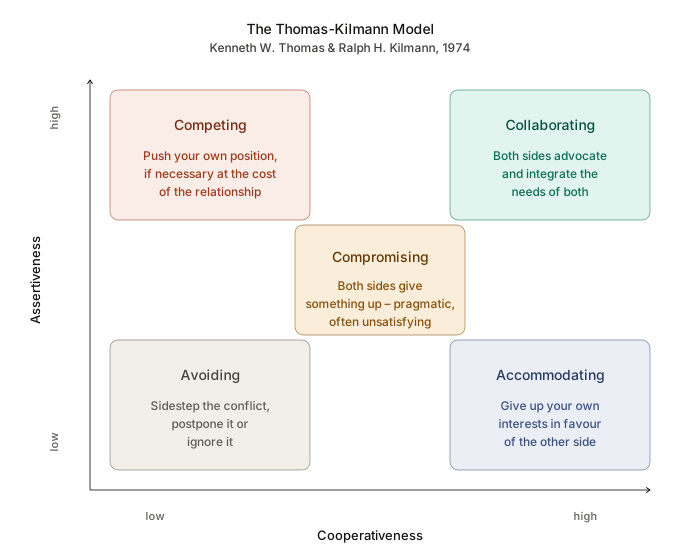
This produces five styles:
Competing, high assertiveness, low cooperation. One's own position is enforced, if necessary at the cost of the relationship. In law firms a frequent default mode: legally trained people are practiced in advocating and enforcing positions.
Avoiding, low assertiveness, low cooperation. The conflict is sidestepped, postponed, or ignored. In partnerships this leads to problems smouldering for years until they erupt.
Accommodating, low assertiveness, high cooperation. One's own interests are given up in favour of the other side. Short term this creates peace, long term it produces imbalance and frustration.
Compromising, medium assertiveness, medium cooperation. Both sides give up something. In many organisations the standard, pragmatic, but often unsatisfying because nobody really gets what they need.
Collaborating, high assertiveness, high cooperation. Both sides advocate for their interests and at the same time work to understand and integrate the other side's interests. This is the most demanding style, and the only one that produces durable solutions in partnerships.
What typically happens in firms, and in many other partnerships: both sides oscillate between competing and avoiding. They argue hard about positions, withdraw, argue again. A compromise is reached but does not hold, because the actual needs were not addressed.
The Iceberg: What Lies Below the Surface
The actual work in the workshop did not begin with the Thomas-Kilmann model. It began with a question that sounds much simpler than it is: what does the other side really need?
Not: what do they demand? Not: what do they say? But: what lies below the surface?
This is where the iceberg model comes in, the insight that in any conflict only a small part is visible. The articulated positions, the demands, the arguments, that is the tip of the iceberg. Beneath lie the needs, the worries, the wounds, the fears that actually drive the conflict.
In the firm it looked like this: on the surface the partners argued about responsibilities, mandate distribution, strategic direction, all factual themes. Beneath lay questions no one had spoken: am I respected as an equal partner? Is my contribution seen? Am I afraid of losing influence? Do I feel passed over in decisions affecting my life's work?
The Moment That Changed Everything
The decisive moment came around halfway through the day-long workshop. Under my guidance both sides began to look at the needs of the other side, holistically. Not only the spoken, but also the unspoken. Not only the positions, but the worries and wounds behind them.
It was the moment when both partners understood for the first time why the other reacted the way they did. What convinced them were not the arguments, but the needs that became visible behind them.
From that point on the dynamic in the room changed fundamentally. The tension eased. Voices became calmer. Conversations became more honest. In Thomas-Kilmann terms: both sides shifted from competing into collaborating. Not on my prompting, but because mutual understanding had created the space for it.
I sometimes say: from that moment on I could have driven home. Working out the solution was then the easy part. The actual work had been done, the mutual understanding of what lay below the waterline.
What This Coaching Taught Me
Three insights from this work have stayed with me ever since:
Conflicts are not solved by better arguments. In a firm where both sides are excellent arguers, the arguments are never the problem. The problem is the unspoken needs and wounds smouldering below the surface. As long as these are not addressed, the argument turns in circles, ever more elegantly, but never to the goal.
Mutual understanding is not weakness. For many leaders, and especially for lawyers, it feels unfamiliar to treat the other side's needs not as a tactical instrument, but as a real concern. Yet it is precisely this moment of honest looking that changes the dynamic. Not as a technique, but as a stance.
Equal footing is a precondition. To ask the difficult questions in a room full of senior partners of a large firm, the questions about wounds, about fears, about what no one wants to say, you need to be able to act on equal footing as a coach. Not arrogant, not subservient, but with the calm confidence that comes from having stood in comparable roles and pressure situations yourself.
When Conflict Coaching Works
Not every conflict needs a coach. But when a conflict has become so entrenched that those involved can no longer move forward on their own, when positions have hardened, trust is damaged, and rational conversations lead into emotional dead-ends, then someone from outside is needed to hold the space, ask the right questions, and guide the participants beneath the surface.
The Thomas-Kilmann model helps to understand the dynamic. The iceberg model helps to make the deeper needs visible. But in the end it is neither the model nor the method that makes the difference. It is the moment when one person truly understands, for the first time, why their counterpart acts the way they act.
From that moment on, collaboration becomes possible.
Further reading
- Thomas-Kilmann Conflict Mode Instrument (Kilmann Diagnostics) – Official source on the TKI with its five conflict modes.
- Coaching for partners and leadership teams in law firms – My field of experience on leadership among co-owners.
Frequently asked questions
- What is the Thomas-Kilmann model?
- A model from conflict research describing five conflict styles: competing, avoiding, accommodating, compromising, and collaborating. They emerge from the dimensions of assertiveness and cooperativeness.
- When is conflict coaching worthwhile?
- When a conflict has become so entrenched that those involved can no longer move forward on their own, when positions have hardened, trust is damaged, and rational conversations lead into emotional dead-ends.
Want to read this offline or share it?