Burnout Coaching: The Grey Zone to Therapy
Burnout or already depression? How I take responsibility as a coach in the grey zone to therapy, an open field report from coaching practice.

There is a moment in coaching practice that is rarely talked about openly. It is the moment when, as a coach, you sense that the person sitting opposite you may need therapeutic support.
I want to talk about such a moment. And about why I nevertheless decided to coach.
What Coaches May Do, And What Not
First the professional frame: coaches are not therapists. We work with people who are mentally healthy. This is not a soft recommendation, it is a professional boundary clearly taught in coach training. Coaching presupposes that the client is able to work on their themes in self-responsibility. As soon as a mental illness in the clinical sense is present, depression, an anxiety disorder, a trauma sequela, the person belongs in the hands of a trained therapist.
That sounds clear in theory. In practice it is anything but.
Because people who reach out to a coach rarely come with a diagnosis. They come with a feeling that something is not right. That they have run out of energy. That work which once gave them joy is now only a burden. That they can barely get out of bed in the morning. And they say: I think I have burnout.
Burnout and Depression: Closer Than You Think
At this point, an honest look at the relationship between burnout and depression is important. Because behind the socially acceptable term "burnout" often hides a reality that, clinically, corresponds to depression.
In the ICD-11, the WHO's international classification system, burnout is not recognised as an independent illness. It is listed under code QD85 as a syndrome, a "consequence of chronic workplace stress that has not been successfully managed". It is therefore an additional diagnosis: doctors can attach it to an existing diagnosis, e.g. "depression with burnout". But burnout alone is not a disease in the medical sense.
Depression, by contrast, is a clearly defined mental illness, with recognised diagnostic criteria, treatment guidelines, and a long research history.
The problem: the symptoms overlap considerably. Exhaustion, lack of drive, loss of interest, cynicism, withdrawal, sleep disturbances, all of this can indicate either burnout or depression. In many cases both are present at once. Ulrich Hegerl, chairman of the Stiftung Deutsche Depressionshilfe und Suizidprävention, the German foundation for depression aid and suicide prevention, once put it well: behind severe cases of burnout there is often a classical depression. But the term burnout makes it easier for those affected to seek help, because it is associated with effort and engagement, not with illness and weakness.
This is the social function of the term: burnout gives depression a face one can show without shame. On the one hand this is helpful, because it lowers the threshold for seeking support. On the other, it can lead to a depression in need of treatment going unrecognised, because all parties prefer to speak of burnout.
As a coach you stand right in this grey zone.
The Story of Paul
I'll call him Paul, the name is anonymized. Paul came to me wanting to work on his professional situation. He was a leader, he managed his everyday life well, yet he sensed that many things felt less effortless than they used to. In the introductory call it quickly became clear that more was at stake than a purely professional reorientation.
There were signs that drew my attention: the way he spoke about his everyday life. A noticeable fatigue that went beyond ordinary work-related strain. A thoughtfulness that gave me pause.
I faced a decision familiar to every coach who works with leaders: do I take this client, or refer him to a therapist?
The decision was not easy. I gave myself time and weighed several factors: how stable does Paul seem? Are there acute signs of a crisis requiring immediate therapeutic intervention? Is he able to work actively on his themes? And: is there the option of running coaching and therapeutic support in parallel?
I decided to coach Paul.
The Work
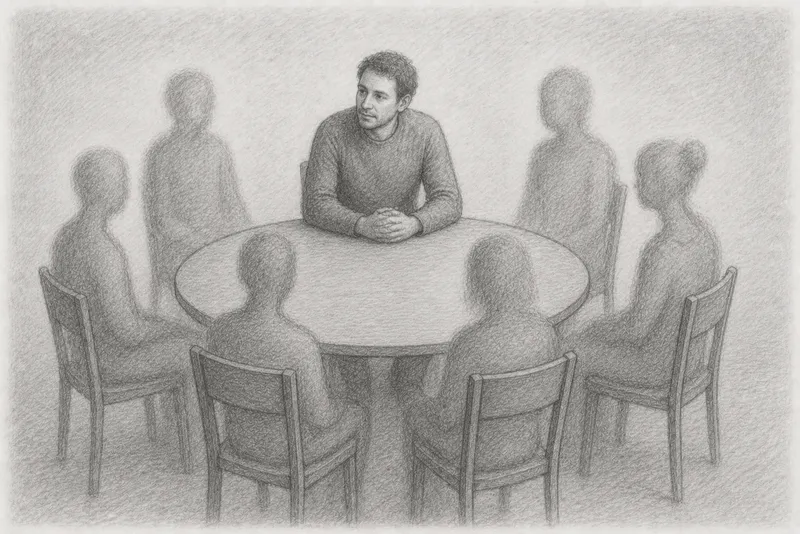
The coaching journey with Paul was intense. We worked with his inner parts, with the inner team, to make visible behavioural structures he could no longer see. We made parts of him visible that had been operating in the background for a long time: protectors that kept him going but also exhausted him. Inner voices telling him that stopping was not an option.
These were not easy sessions. But Paul was willing to look. And with each session he won back something he had thought lost: access to himself.
Throughout the entire process I paid attention to whether the boundary into therapeutic territory was being crossed. There are moments where I, as a coach, pause and ask myself: is this still my terrain? This vigilance is part of professional responsibility.
The End of the Journey, And a Letter
At the interim end of our shared coaching journey, Paul asked whether he could send me something. I said it was not necessary.
A few days later there was a parcel in the mail. Inside: a 7" single by the singer Clueso. The song "Neuanfang" (New Beginning). Signed by the artist. Inside the cover lay a handwritten letter. The last sentence read:
"Thank you for my new beginning."
I am not writing this to celebrate myself as a coach. I am writing it because that moment reminded me why the difficult decision at the beginning was the right one. And because it shows what is possible when a coach has the sensitivity to act responsibly in the grey zone, instead of reflexively saying no.
What I Have Learned
From the work with Paul and similar clients, I have developed a few principles that have guided me ever since:
Coaching and therapy are not an either/or. In some cases both run in parallel, and that is expressly sensible. The therapist works on the clinical level, the coach on professional and personal development. I see this constellation regularly and consider it one of the most effective forms of support.
The boundary is not always a line, sometimes it is a space. Between "clearly healthy" and "clearly ill" lies a wide grey zone in which most people who come with burnout themes live. In this grey zone, coaching can create enormous value, provided the coach stays vigilant and is ready to refer the client onward as soon as it becomes necessary.
The fingertip feeling cannot be delegated. No diagnostic scheme can replace the judgment of whether a particular person, in a particular moment, is coachable. This assessment requires experience, empathy, and the willingness to say no when in doubt, even when the client is seeking help urgently.
Sometimes taking the person on is the more responsible decision: with clear eyes, with clear boundaries, and with the awareness that the client can and must be passed on whenever the situation requires it.
I am still working with Paul today.
Further reading
- WHO: Burn-out as an occupational phenomenon (ICD-11) – The WHO's official classification since 2019.
- Mayo Clinic on burnout vs. depression – Clinical guidance on the boundary between burnout and depression.
Frequently asked questions
- Is burnout the same as depression?
- No. Burnout is listed in the ICD-11 as a syndrome (QD85), not an illness in its own right. However, classical depression often lies behind severe burnout cases. The symptoms overlap considerably.
- When should a coach refer a client to a therapist?
- As soon as signs of a treatment-requiring mental illness appear. Coaches work with mentally healthy people. With depression, anxiety disorders, or trauma sequelae, the person belongs in therapeutic care, ideally in parallel to coaching.
Particularly relevant for
Want to read this offline or share it?
Related posts
IFS in Executive Coaching: A Field Report
IFS-informed coaching with healthy leaders: a field report on impact, applications, and the clear distinction from psychotherapy, and why I am continuing the IFS coaching training in 2027.
Thought First, Then Feeling: Manage Stress
Diekstra's 5G model shows: first the thought, then the feeling. How leaders defuse stress and fear by recognising their automatic appraisals.