Thought First, Then Feeling: Manage Stress
Diekstra's 5G model shows: first the thought, then the feeling. How leaders defuse stress and fear by recognising their automatic appraisals.
There is a book that has fundamentally influenced my work as a coach. It is called Ik kan denken/voelen wat ik wil, in English roughly: "I can think and feel what I want", written by Prof. Dr. René F.W. Diekstra, a Dutch psychologist and emeritus professor. The book has been in print for over 40 years, now in its 30th edition, and has helped hundreds of thousands of people understand their thoughts and feelings better.
The central idea is strikingly simple: it is not events that produce our feelings, it is our thoughts about the events.
The Lion in the Tram
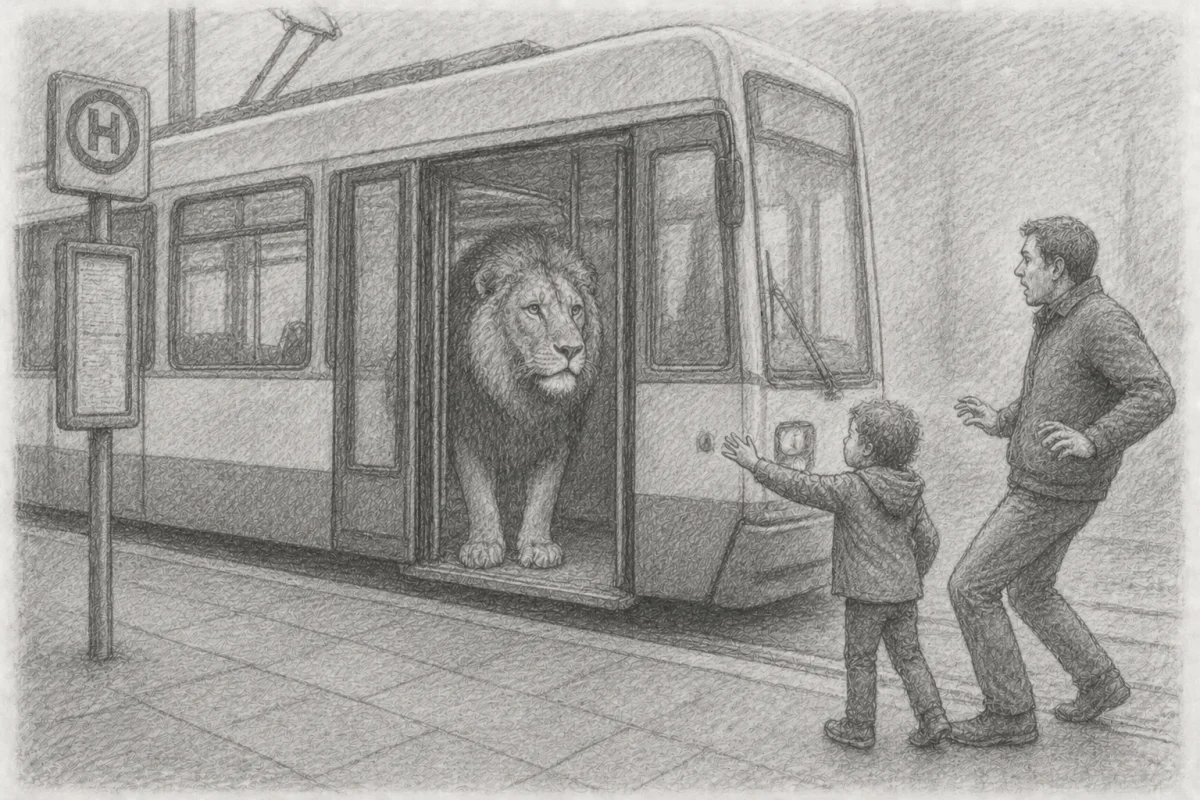
Diekstra uses a memorable example: imagine you are sitting in a tram, and at the next stop a lion gets in. What happens?
Your first impulse would presumably be: fear. Panic. Flight.
But why? The lion is not dangerous per se; he becomes dangerous through a thought: He could eat me. This thought, lightning-fast, automatic, barely conscious, produces the feeling of fear. And the fear produces the behaviour: you flee.
Now imagine a small child sitting in the same tram. A child who has never heard of the dangerousness of a lion. What would it do? Maybe walk towards the lion. Maybe try to pet him. Because the thought He could eat me is missing, the fear is missing too.
The same event, a lion in the tram, produces completely different feelings in two people, because the thoughts about it are different.
The 5 G's: A Model for Self-Reflection
Diekstra captured this connection in a simple model he calls the five G's:
Gebeurtenis (Event) → Gedachte (Thought) → Gevoel (Feeling) → Gedrag (Behaviour) → Gevolg (Consequence)
The decisive point is the second step: the thought. Between the event and the feeling there is always a thought, often so automatic and so fast that we don't even notice it. We experience the feeling and believe the event triggered it directly. But in truth it was the thought in between.
This is not a new insight. It goes back to the rational-emotive therapy of Albert Ellis, with whom Diekstra worked. But the way Diekstra makes it accessible has made the concept usable for hundreds of thousands of non-therapists.
The consequence is far-reaching: if the thought produces the feeling, then we can change the feeling by changing the thought. The path runs neither through suppressing the feeling nor through altering the event. It runs through becoming aware of the thoughts that lie between event and feeling, and checking whether they help us or not.
Diekstra here distinguishes between "helpful" and "non-helpful" thoughts. Non-helpful thoughts are not wrong in a logical sense, they are dysfunctional. They produce feelings that prevent us from acting the way we actually want to.
What Shawn Achor Says
For those who would like to encounter this thought in another context, I recommend the TED talk The Happy Secret to Better Work by Shawn Achor. Achor, a researcher at Harvard University, shows there that most people invert the formula: they believe success leads to happiness. In truth it is the other way around, a positive inner stance improves performance, creativity, and the ability to deal with stress.
This sounds like popular psychology but is well supported by neuroscience. And it touches the same core as Diekstra's work: our inner stance, that is, our thoughts, determines how we experience the world and how we act in it. Not the other way around.
Stress as a Secondary Feeling
In my coaching work with leaders I encounter this mechanism constantly. People come to me and say: "I'm stressed." Stress is the feeling they can name. It is socially accepted, it fits the context of a demanding leadership role.
But in many cases stress is a secondary feeling. Looking deeper, often something else lies behind it: fear. Fear of failure. Fear of losing control. Fear of being judged. Fear of not being enough.
This fear is rarely spoken because it does not fit the image of a competent leader. So it disguises itself as stress, a socially acceptable term, just as burnout can be the socially acceptable disguise of a depression.
But if we stop at "stress", we reach for stress-management techniques: time management, prioritisation, delegation. All of that can help. But if the actual cause is fear, better time management does not solve the problem, because it does not address the thought that produces the fear.
Why I Know This Approach, A Personal Experience
I do not work with this approach only theoretically. It helped me personally to handle one of the most difficult situations of my career as a leader.
I was facing the decision to part ways with an employee. He had already been given two chances to improve the situation. The factual reasons for the separation were clear. But then he told me that a dismissal would lead to the loss of his residence permit.
In that moment I was overwhelmed. The factual decision was made. What overwhelmed me was the scale of what it would mean for this person. And the perception I would have inside the company: the cold-hearted boss plunging someone into an existential crisis.
What I felt at the time, I called stress. In truth it was fear. Fear of the consequences of my decision. Fear of the judgment of others. Fear of being perceived as inhuman.
A psychologist I consulted at that time, an outstanding therapist to whom I owe much, helped me understand exactly this mechanism. We analysed my thoughts that lay between the event (the impending separation) and my feeling (the fear). Thoughts like: If I do this, I am a bad person. Everyone will think I am cold-hearted. I am to blame if his life is destroyed.
These thoughts were not wrong, they contained real concerns. But in their absoluteness they were not helpful. They paralyzed me. They made me incapable of acting in a situation that demanded a decision.
The work consisted in letting these thoughts stand and supplementing them with more differentiated, more helpful ones: I gave him two chances. The decision is factually justified. I can handle the separation respectfully and fairly. I am co-responsible for the situation, but not for his entire life.
The fear did not disappear. But it became manageable. I could think clearly again. And I could make the decision, not coldly, but with the necessary clarity and as much compassion as the situation allowed.
What This Means for My Coaching
This experience showed me how powerful the connection between thoughts and feelings is, not as theory, but as lived reality. And it is the reason why, with leaders complaining of stress, I almost always go one level deeper.
The question is never just: what stresses you? The question is: what do you think about the situation that stresses you? And: does this thought help you, or hold you back?
Often these are thoughts that emerged in an earlier phase of life and have run unchecked ever since. Thoughts like I must not make mistakes, I have to keep everything under control, If I show weakness I lose respect. They may once have been functional. But in the current role, with the current responsibility, they produce feelings that no longer fit.
The work does not consist in prescribing positive thinking. That would be superficial and ultimately ineffective. The work consists in becoming aware of the automatic thoughts, understanding their function, and checking whether they can be supplemented or replaced by more differentiated, more helpful ones.
Diekstra calls this the transition from "non-helpful" to "helpful" thoughts. In coaching I experience it as one of the most effective levers there is.
Further Reading
- René F.W. Diekstra: Ik kan denken/voelen wat ik wil, 30th edition
- Shawn Achor: The Happy Secret to Better Work (TED Talk)
- Albert Ellis: founder of rational-emotive behavior therapy (REBT), on which Diekstra's work builds
- Applying these psychological insights to high-performance environments like professional sports.
Further reading
- René F.W. Diekstra: Ik kan denken/voelen wat ik wil (Pearson, 30th ed. 2018) – The standard work on the 5G model.
- Shawn Achor: The Happy Secret to Better Work (TED Talk) – How thought patterns drive performance and wellbeing.
- Albert Ellis: Founder of Rational Emotive Behavior Therapy (REBT) – The basis Diekstra's work builds on.
- These insights applied to elite sport – Transfer to high-performance environments.
Frequently asked questions
- What is the 5G model?
- The 5G model by Prof. Dr. René F.W. Diekstra describes the chain: Gebeurtenis (event) → Gedachte (thought) → Gevoel (feeling) → Gedrag (behaviour) → Gevolg (consequence). The decisive step is the thought between event and feeling, often so automatic and fast that we don't notice it. Once you see this thought, you can change what follows.
- Why is stress often just a cover?
- Stress is frequently a secondary feeling that masks an underlying primary one, usually fear: of failure, of losing control, of being judged, of losing status or security. Stress is the socially accepted label, fear the more honest one. Recognising this gets to the actual root and lets you work with the cause instead of merely managing symptoms.
- How can you replace unhelpful thoughts?
- First make the automatic thought visible, then deliberately replace it with a more realistic one. Example of a respectful separation from an employee: instead of "I must not disappoint her, I'm responsible for her career" it becomes "I am making an honest decision in the interest of the organisation and I respect her as an adult who can handle this information." The event stays the same, but the feeling, the behaviour, and the consequence change.
Particularly relevant for
Want to read this offline or share it?
Related posts
When the Job Wobbles: Circle of Influence
On the two sides of job insecurity in mechanical engineering, automotive and steel: the fear of losing your own job and the burden of having to lay others off.

Burnout Coaching: The Grey Zone to Therapy
Burnout or already depression? How I take responsibility as a coach in the grey zone to therapy, an open field report from coaching practice.