Harbour Master: Why Parallel Means Late
On Eliyahu Goldratt's Theory of Constraints, Critical Chain Project Management, WIP limits in agile software development, and the courage to bundle resources instead of running everything in parallel.
"We have to push all projects forward in parallel, they are all priority one!"
I hear this sentence often when I work with engineering directors or managing directors on the efficiency of their teams. Recently I sat with the technical director of a machinery company. His people were at the limit, the lists were long, and finished products only trickled to market.
I told him a story that also appears in my book: the harbour master principle. The metaphor comes from the world of Critical Chain Project Management (CCPM) and illustrates one of the most important tenets of Eliyahu Goldratt's Theory of Constraints: concentration beats distribution.
Three ships and the logic of waiting
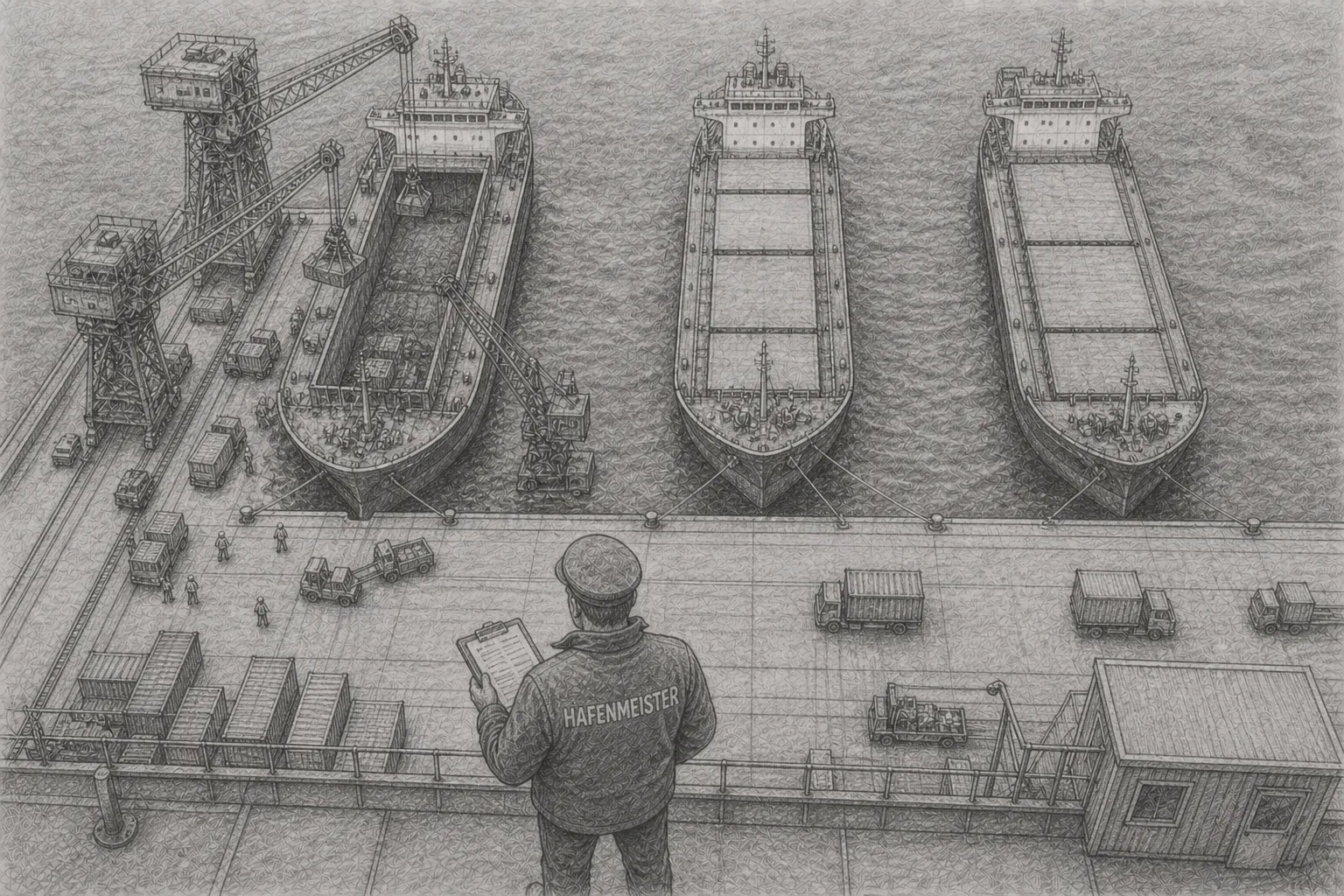
Imagine three ships sit in your harbour. All three captains are in a hurry and want to put back to sea as quickly as possible. You have three unloading crews. Each crew alone needs three days for one ship. Together they manage in one day.
Two options.
The first is the standard reflex: each crew grabs a ship. All work in parallel. Result: all three ships are done after three days. No captain has to wait, all are served at the same time. Sounds fair.
The second is the harbour master principle: all three crews unload the first ship, then the second, then the third. Ship one leaves on day one. Ship two on day two. Ship three on day three.
Total time in both cases is three days. The decisive figure is port time. With the parallel option the ships sit in port for nine days in total (three times three). With the sequential option for only six (one plus two plus three). One third less.
If these ships sail for the same shipping company, the sequential option is the only logical choice. Every ship that leaves earlier earns money earlier. In product development this means: a finished product generates revenue, while an "almost finished" project only incurs cost.
Goldratt's Theory of Constraints: the foundation
The harbour master principle illustrates a deeper one: the Theory of Constraints from the Israeli physicist and management theorist Eliyahu M. Goldratt. In his bestseller The Goal (1984) Goldratt formulates a central insight: in every system there is exactly one bottleneck that determines the throughput of the whole system. Improvements anywhere else are ineffective until the bottleneck is addressed.
From this Goldratt developed Critical Chain Project Management (CCPM), a method that translates the harbour master principle into project steering: resources are concentrated sequentially on projects instead of being diluted in parallel. The relay-runner principle, a related concept from CCPM, complements the idea: tasks are passed on dynamically as soon as a section is finished, instead of being tied to calendar milestones.
In the harbour example the bottleneck is unloading capacity. With the parallel option this capacity is spread across three ships and diluted. With the sequential option it is concentrated on one ship at a time. Throughput of the system rises because capacity acts where it has the greatest effect.
In agile software development this principle is known as a WIP limit: a deliberate cap on "Work in Progress". Teams that limit their parallel tasks demonstrably deliver faster than teams that work on everything at once. The mechanic is the same as in the harbour.
Why we still spread ourselves thin
In theory the harbour master principle is obvious. In practice it regularly fails on psychology.
The various "captains" in a company – department heads, product managers, sales leads – cannot agree on a priority. Each holds their own ship to be the most important. Nobody wants to make anyone wait, and in the end everyone waits at the same time. The result: overloaded teams that work on five projects and finish none of them on time.
The opportunity costs of this simultaneity are rarely measured. We see the overload of staff. We see the overtime and the rising sickness rates. But we rarely see the money the company misses out on because project A is finished in December instead of July. These hidden costs are real; they simply do not appear in any balance sheet.
In my article When the job wobbles I describe Stephen Covey's distinction between the Circle of Concern and the Circle of Influence. A leader who runs all projects in parallel is operating from the Circle of Concern: trying to please everyone, attending to worries that prioritisation could resolve. A leader who has the courage to say "Ship one first" is operating from the Circle of Influence.
Focus as a leadership task
Of course there are nuances in reality. Sometimes you have to wait for parts or test results, and it is sensible to fill the gap with a second topic. No principle replaces judgement. But the underlying rule stands: finish before you start.
Leadership here means having the courage to prioritise. It means explaining to the captains of ships two and three why they have to wait briefly so that the company as a whole can move faster. That is not a pleasant conversation. It requires the ability to handle pushback and to stay with the decision even when pressure comes from several directions.
In my article Nonviolent Communication and the Triple Buffer I describe techniques for exactly such conversations. The prioritisation itself is the easy part. The hard leadership work is communicating it.
A prompt for your week
Take a look at your project list. How many ships are you unloading at the same time? And how much faster could you be if you bundled your forces?
It is rarely about more workforce. It is almost always about a decision: which ship leaves first?
Further reading
- Eliyahu M. Goldratt: The Goal (North River Press 1984) – The classic on the Theory of Constraints.
- Eliyahu M. Goldratt: Critical Chain (North River Press 1997) – Application of the constraint theory to project management (CCPM).
- My book Peter mag keinen Frosch zum Frühstück (Amazon) – The Harbour-Master Principle in the context of leadership decisions.
- Maslow's Hammer: Expand the Toolbox – Why a single tool rarely suffices for questions of prioritisation.
Frequently asked questions
- What is the harbour master principle?
- The harbour master principle is an illustration of Eliyahu Goldratt's Theory of Constraints. Three ships can either be unloaded in parallel (each team on one ship) or sequentially (all teams on the first ship). Total time is the same, but the cumulative time the ships sit in port is roughly halved with sequential work. In product development this means: a finished product earns money, an "almost finished" one only causes cost.
- Why do teams still spread themselves across parallel projects?
- The various "captains" in a company – department heads, product managers, sales leads – often cannot agree on one priority. Each holds their own project to be the most important. Nobody wants to make anyone wait, and in the end everyone waits at the same time. On top of that come invisible opportunity costs that never appear in any balance sheet.
- How does "Finish before you start" work in practice?
- In agile software development WIP limits (Work in Progress) are the concrete application. Teams deliberately cap the number of parallel tasks and demonstrably deliver faster. Goldratt's Critical Chain Project Management transfers the principle to project steering with the relay-runner principle: tasks are passed on as soon as a section is finished, instead of being tied to calendar milestones.
Particularly relevant for
Want to read this offline or share it?
Related posts
Where we look last for answers
An old parable about inner peace meets a systemic principle: when something outside is stuck, the most reliable lever lies in our own state and our own behaviour.

The Emotional Veto: When One Person Shifts the Rules for Everyone
One team member reacts so strongly to criticism, conflict or change that everyone eventually begins to organise themselves around his reactions. That creates a veto nobody ever granted him.