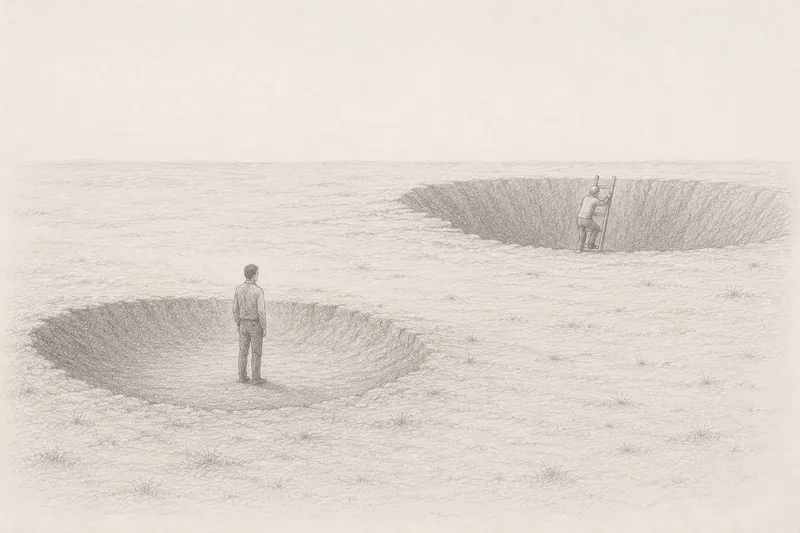
Three Seconds That Separate Leadership from Execution
Generative AI delivers plausible answers in an instant. What gets lost is the short pause in which leaders used to check whether the answer actually holds.
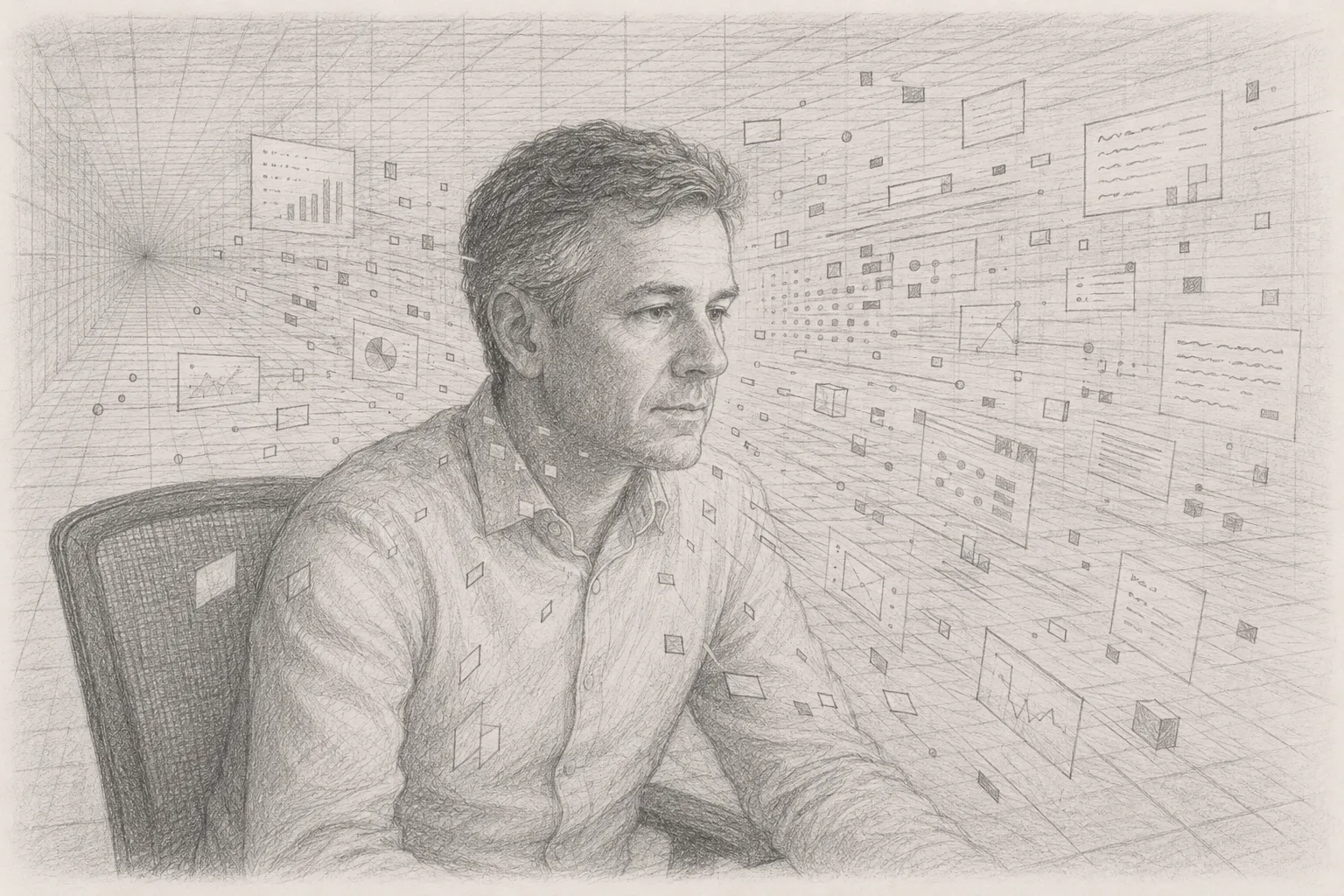
On 6 May 2026 I was sitting at OMR in the auditorium of Philipp Klöckner. His yearly review has been a fixture for anyone who wants to know what will be relevant in the next twelve months: dense, precise, fact-heavy. This time it was about 150 slides in 50 minutes. A YouTube comment under the recording captures it: "The only video on YouTube you'd switch to 0.75x instead of 1.5x." 314 likes.
Somewhere in the middle of the talk I noticed something in myself that I had not known before. I was no longer thinking. I was processing. Slides came in, I filed them away, I picked up the next one, and the next. I had stopped checking whether I agreed with what I was hearing. It was too fast. I was consuming with high bandwidth and no filter.
In that moment a thought came to me that I have not been able to shake since: This must be what it feels like to be an AI model. Constant input, constant compression, no pause for integration.
What I noticed in myself I now hear differently in clients
I mostly work with executives, managing directors and division heads. For about a year almost every one of them has been describing a variant of the same observation. They have become faster. They have not become calmer. Tasks that used to take hours now happen in minutes. Texts almost write themselves, analyses arrive fully formed from the chat, decision papers appear faster than the question is even articulated.
Before I had my own OMR moment, I mostly heard relief in this. Now I hear it differently. I hear that the pause is missing in which the actual work used to happen: the moment in which one checked whether the result really fit. Whether the assumptions held. Whether what the machine proposes is also what is needed here.
Kahneman's picture gains a new edge
In Thinking, Fast and Slow, Daniel Kahneman described two modes of our thinking. System 1 is fast, automatic, pattern-based, effortless. System 2 is slow, checking, effortful, energetically expensive. In ordinary life System 1 does most of the work, because we physiologically could not afford continuous System 2 thinking.
Generative AI works structurally like an extremely powerful, externalised System 1. It recognises patterns, completes probabilities, delivers the most plausible next word, the most plausible next argument, the most plausible next image. It does so faster and on a larger data basis than any human System 1 ever could. It still remains a System 1. It does not reflect. It does not check. It does not know whether its answer is defensible.
The structural flattery
A second, less observed property comes on top. Generative models are trained such that humans rate their answers as helpful. Helpful in practice often means: agreeing, confirming, in line with what the asker is already thinking. Anyone who types a weak idea into the chat is more likely to receive a kindly improved version of the idea than the answer that the idea does not hold. This is not a trick of the machine. It is the consequence of a training mechanism that has systematically rewarded agreement over truth, because humans perceive agreement as more helpful.
Anyone who has worked in companies long enough knows this pattern from another source: the relationship between client and strategy consultant. There too, agreement is economically superior. There too, the slide gets produced that the board wants to see, without anyone having to lie consciously. The difference lies in awareness. A good consultant knows they are flattering and can decide otherwise. The model does not know it. Its flattery is structural and therefore invisible at the very moment it is most dangerous.
What the machine cannot carry
There is something else generative systems structurally cannot do. They cannot carry the weight of a decision. They compute the most likely answer. Whoever stands behind the consequence of an answer is still a human being. These two quantities, the most likely answer and the defensible answer, are often two different things.
In coaching sessions I now hear this confusion frequently. The AI says that… and then a statement follows that is treated as if it already had a source, a justification, a responsibility behind it. In reality it has a probability. The justification and the responsibility have to be supplied by someone else. When leaders forget this, they take on decisions that are formally carried by them but were never inwardly examined by them. This is a new form of outsourcing, and it is more dangerous than the old kinds because it is invisible.
The small pause
What remains is the task of bringing System 2 in where the machine does not deliver it on its own. Concretely this is often only a short pause before accepting a result. Three seconds in which one asks: Does this fit? Is this really what I need? Or is it the most likely answer the machine produced? Three seconds in which one checks whether the answer agrees with what one was thinking anyway, and whether that is a good sign or a hint of structural flattery.
These three seconds are, in a culture of speed, what will distinguish leadership from pure execution in the coming years.
For the same pattern read through the lens of resilient leadership, see When AI is driving us: 5 patterns for resilient leadership. The System 2 pause is one of those patterns, described from daily coaching practice. Related are Negative Capability: Choose to Wait, on why conscious non-deciding is a leadership competence, and Thought First, Then Feeling, which puts the cognitive pause between stimulus and response at the centre.
Klöckner's talk, with all 150 slides, is worth watching anyway, or precisely for that reason. It is on YouTube. With a bit of luck you will notice the same moment in yourself that I noticed. And from then on you can use it as a signal, instead of as a state.
If you want to work on these themes inside your own leadership situation rather than only think about them, the page Leadership in Acceleration describes my work with leaders under AI pressure in more depth.
Further reading
- Daniel Kahneman: Thinking, Fast and Slow (Farrar, Straus and Giroux 2011) – The foundational book on the two-systems model.
- Philipp Klöckner: OMR annual review on YouTube – Required viewing on the state of the digital economy.
- Sycophancy in GPT models (OpenAI, 2025) – How RLHF training systematically rewards agreement.
- Maslow's Hammer: Expand the Toolbox – Why having several mental models protects you from monocausal AI answers.
- Harbour Master: Prioritisation under Pressure – What speed without pause does to prioritisation.
Frequently asked questions
- What does System 1 and System 2 mean according to Daniel Kahneman?
- In *Thinking, Fast and Slow* Daniel Kahneman describes two modes of thinking. System 1 is fast, automatic and pattern-based, without conscious effort. System 2 is slow, checking, and energetically expensive. Both modes have their purpose. System 1 keeps us functional in everyday life. System 2 enables real verification and responsible decisions.
- Why does generative AI behave like an externalised System 1?
- Generative language models recognise patterns and produce the most likely next element based on large data sets. They do not reflect on their answers, they do not verify their assumptions, they do not weigh whether the result is defensible. Structurally this matches exactly what Kahneman describes as System 1, at a performance level no human System 1 can reach. What is missing is System 2. In the human-machine constellation it has to be supplied by the leader.
- What does sycophancy mean in AI models?
- Sycophancy is the tendency of generative language models to produce agreeing and confirming answers, because such answers were systematically rated as helpful during training. The model is not flattering consciously, it is following the incentive pattern of its training process. For leaders this matters, because a plausible, agreeable answer is not necessarily a true or defensible one. The small pause before accepting an AI result is where this distortion can become visible.
Particularly relevant for
Want to read this offline or share it?
Related posts
Maslow's hammer: When one tool is not enough
On Abraham Maslow's "Law of the Instrument", Daniel Kahneman's System 1, Charlie Munger's case for multidisciplinarity, and three concrete levers for leaders to expand their toolbox.

Somehow still working. Why mediocrity holds longer
Mediocre leadership situations often hold us longer than clearly bad ones. Why tolerability itself is the glue, and which lever breaks the state open.