Before your body pulls the emergency brake
There is a phase in which you wake at night and your head is still calculating. Tomorrow's calendar, the board conversation, the email you didn't answer. A faint knot in your stomach that won't go away. You notice the weekend no longer tastes like recovery. You are more irritable than you want to be. You tell yourself: this is normal, it's a busy time, it will pass.
Sometimes it passes. Sometimes it doesn't.
Behind the stress lies something else.
What presents itself as stress, in most coaching engagements I run, is not primarily a time problem. It is fear. A fear that doesn't call itself by name, because the word isn't allowed at the leadership level. Instead it arrives as exhaustion, as irritability, as sleep disturbance, as the diffuse sense of losing control over your own life.
With the leaders I work with, it is usually fear of mistakes. It is closely tied to fear of losing the job, losing relevance, being visible as someone who is no longer enough. And it reinforces itself: when layoffs are announced, everyone thinks they can afford even fewer mistakes. When the industry is shaking, everyone thinks they must perform more than the others. Fear becomes the engine that demands ever more output.
This is the movement that carries many leaders into exhaustion: too much anxiety-driven work, not simply too much work.
Why working more doesn't help
In this situation many reach for the obvious answer: work even more. Longer hours, denser schedules, more done. This has a subtle second function that is rarely spoken aloud. Whoever gives everything can hardly be criticised afterwards. "I went beyond my limits, I did everything." Over-exertion becomes a strategy for avoiding criticism, often without the person being aware of it.
That is why classical time management fails here. Telling a leader in this phase to take breaks, prioritise more clearly, or learn delegation rules treats the symptom at the wrong level. The over-work is not the actual problem. It is the solution the anxious part has found. As long as the fear is not seen, it will keep looking for solutions, and more work is the most obvious one.
Perspective shifts and mindfulness exercises often fail here too. These methods are not without value. But they operate at the behavioural level, while the engine runs one level deeper. A morning breathing exercise can ease the day. The fear that rises again at four in the board meeting is untouched by it.
What truly helps here is a different movement: turning toward the fear itself.
Recognising the good in fear
In my work I call this working with one's own parts. The term is deliberately concrete. We all have inner parts: one that wants the career, one that seeks rest, one that doubts, one that wants to keep up. In people under pressure, an anxious part often shows itself carrying the load: it is the one that organises the over-work, that calculates at night, that produces the knot in the stomach.
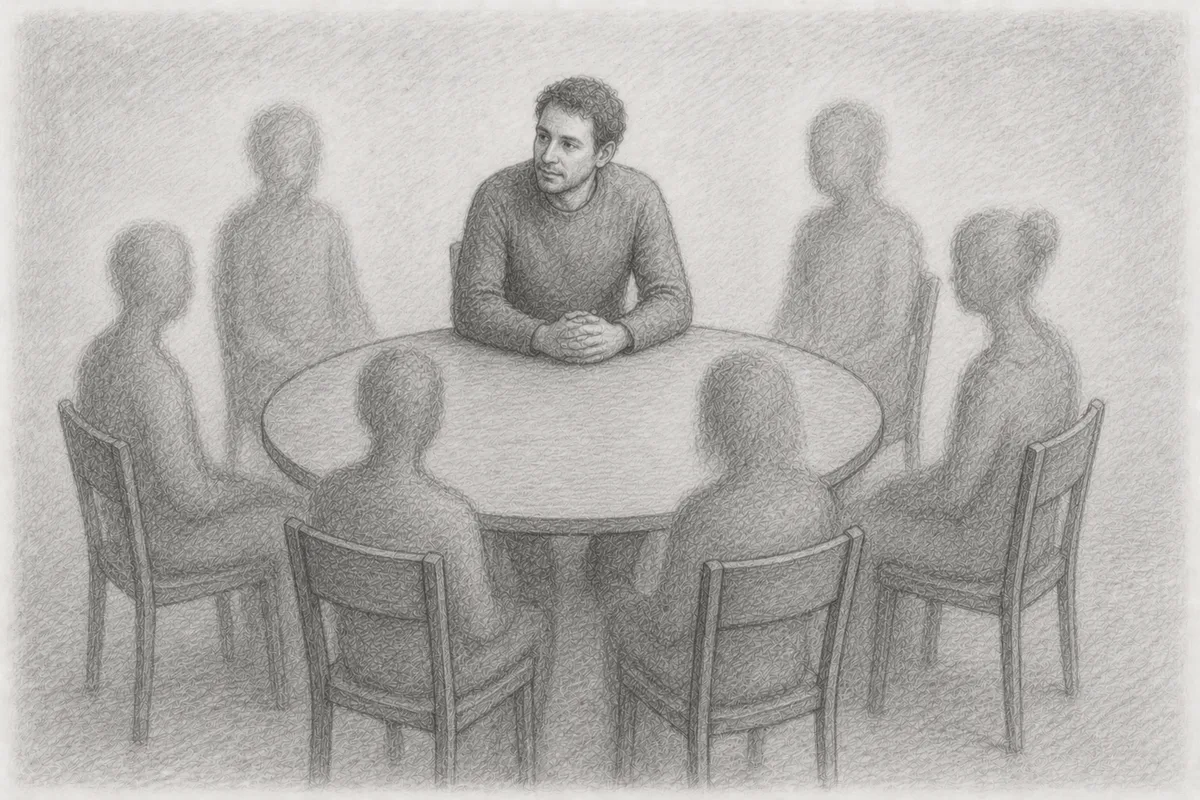
Most people don't like this part at first. It feels disturbing, paralysing, embarrassing. The usual answer is to push it away: don't look, keep going, function. That is exactly what amplifies the problem. The pushed-away part keeps working in the background, with more and more energy, because it is not being heard.
The work I offer starts with a simple but unfamiliar question: what good does this anxious part actually intend for you? The answer comes hard at first, because most people have not learned to credit their burdensome parts with good intentions. But every such part has a positive intention. The anxious part wants to protect you from the mistake that would cost you something. It means well. It has simply chosen means that exhaust you over time.
When a client takes this step, when the anxious part is heard rather than pushed away, something remarkable happens. The fear becomes less. It does not disappear; it simply no longer has to work in the background. It is seen, heard, given a place. It loses its distorting power.
From this, room for change opens up. A different answer to the pressure situation than more work. A form of sovereignty rooted in inner order rather than in mere functioning.
An example
A client I worked with noticed himself that he was talking disproportionately much in meetings. Others got little airtime. He found it uncomfortable and wanted to change it. The obvious solution would have been: talk less, listen more, follow conversation rules. That would have been behavioural coaching. We would not have gotten far.
Instead we looked at the part that drove him to talk. What was it seeking? What did it want to prevent? After some listening it became clear: as long as he was speaking, he could not be criticised in that time. The talking was an act of avoiding criticism. It was not about vanity, not about dominance, not about lack of self-control. It was an anxious protective mechanism.
That was an eye-opener for him. I had not taught him anything new about communication. He saw the mechanism behind his own behaviour. From then on he could deal with the part differently. He could notice it, acknowledge it, and still decide to give others space. Talking less suddenly stopped being a discipline exercise. It became a form of sovereignty he no longer had to enforce.
How I work
In my coaching practice I have seen this dynamic for years in many variations. With more than 1,000 coaching sessions completed, a clear pattern has emerged that can be accompanied in a structured way.
Coaching in this phase moves through three steps that flow into one another.
In the first step we enter through the thoughts. Which thoughts produce the fear? What runs through your mind when the knot in the stomach forms? Thoughts are, for most clients, more accessible than feelings. They can be named, examined, articulated. We take an honest stocktake: what really drives the tension? Which fears work in the background? Which external factors amplify them, which inner patterns sustain them?
In the second step we begin the work with the parts. We get to know the anxious part, hear its story, understand its intention. Here I draw on methods I integrate from systemic coaching, the inner-team model, and Internal Family Systems. They speak different languages and describe similar phenomena: that we are inwardly multi-voiced, and that healing begins when these voices enter into relation.
In the third step we close the circle and return to the thoughts. Which thought should be present instead, one that produces a different feeling? This is not an exercise in positive thinking. It is the deliberate search for the thought that is true, that holds, that does not gloss over inner reality but clarifies it. From this new thought a different feeling arises, and from the different feeling a different range of action in leadership.
Who this work is for
As a coach for burnout prevention with leaders, I work with people who are still functioning in daily life. Who meet their tasks, keep their appointments, see their families. But who sense that something is no longer right. Bad sleep, but still sleep. Irritability, but still self-control. Exhaustion, but still capacity to perform.
The prerequisite is not previous coaching experience, but a willingness to look honestly at one's own situation, including where it gets uncomfortable.
This work is not for you if you are in an acute burnout phase in which daily life, sleep, and social life have largely collapsed. Then your exhaustion belongs in therapeutic care. Coaching is not the place where clinical exhaustion is treated. The boundary is clear, and I respect it. If you need therapeutic help, I will help you find it.
How I think about these topics
If, before a first conversation, you want a closer impression of how I think, these texts may be useful:
- The coaching grey zone in burnout topics where I locate the boundary between coaching and therapy.
- Thoughts create feelings the theoretical core of how I think about the entry point into this work.
- The emotional bank account in leadership why inner resources are not a luxury but a foundation of leadership.
First conversation
A first conversation lasts about thirty minutes and is non-binding for you. We clarify what is on your mind, whether my approach fits your situation, and in what rhythm working together would make sense. I ask less about CV and more about the current pressure situation. Bring no preparation other than a willingness to speak openly.